Hall Bulldog in the Press: 1931-1932 Newspaper Coverage


Part of The Hall Bulldog Project — documenting Bob Hall's 1932 Thompson Trophy racer.
Explore the Project →About This Collection
The Hall Bulldog captured significant press attention during its brief but exciting 1932 racing season. This collection of newspaper clippings traces the story from Bob Hall’s departure from the Granville Brothers in late 1931 through the Thompson Trophy Race in September 1932.
Publications Represented
The coverage came primarily from local Massachusetts newspapers, with national outlets picking up the story as race day approached:
- Springfield Republican (later The Republican) — The primary chronicler of the project, with nearly daily coverage during August 1932. As Springfield’s leading newspaper, it had front-row access to developments at nearby Bowles-Agawam Airport.
- Springfield Daily News — A rival Springfield paper that also covered local aviation developments.
- Boston Globe — Regional coverage of New England aviation news.
- Flying Magazine — The leading aviation publication, which featured technical specifications.
- National Wire Services — Stories appeared in papers from Ohio to Washington State as the Cleveland races drew near.
The Story in Headlines
These clippings tell a dramatic story of ambition, engineering, and last-minute drama. Bob Hall, fresh from designing the Gee Bee Z for the Granville Brothers, struck out on his own to build a Thompson Trophy contender. Backed by the Guggenheim family and commissioned by wealthy aviator Russell Thaw, the Bulldog took shape at Bowles-Agawam Airport in just a few months.
The press followed every development: the innovative gull-wing design, the powerful Pratt & Whitney Wasp engine, the nail-biting test flights plagued by tire blowouts and mechanical troubles. Then came the bombshell—just days before the Cleveland races, Thaw announced he wouldn’t fly the plane, calling the gull-wing “not suited for racing.”
Hall’s response? He climbed into the cockpit himself, flew to Cleveland, qualified at over 245 mph, and finished sixth in the Thompson Trophy Race. It’s a story of determination in the face of adversity, captured in real-time by reporters who had no idea how it would end.
The Clippings Timeline
Click on any thumbnail to view the full-size clipping in the lightbox gallery.
November 15, 1931
1931
Springfield Union Sunday Republican

Students at Baltrun Flying School have completed a two-place biplane and are now planning to build a gull-wing monoplane designed by Robert L. Hall, formerly of Granville Brothers. The new racing plane is expected to make over 180 mph with a Warner 110-horsepower engine and will be built at the Springfield airport.
Title: Students at Baltrun Flying School, Keywords: Gull-wing monoplane planned for winter construction. Mentions Hall's connection to Granville Brothers and target speed of 180+ mph with Warner 110hp engine.
November 21, 1931
1931
Springfield Republican
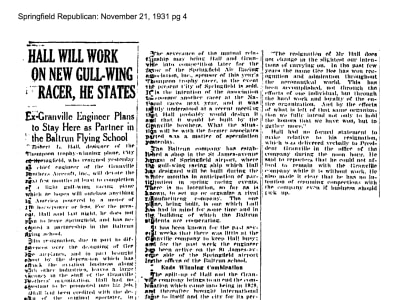
Robert L. Hall, designer of the Gee Bee 'City of Springfield' racing planes, announces he will work on a new gull-wing racer after leaving Granville Brothers. Hall has entered a partnership with Baltrun Flying School and hopes to build a racing ship for the 1932 National Air Races.
Title: Hall Announces Partnership, Keywords: Hall announces partnership with Baltrun Flying School. Ex-Granville engineer plans to build gull-wing racer.
December 8, 1931
1931
Springfield Daily News

Robert L. Hall, former chief engineer for Granville Brothers, is buying an interest in the Baltrun Flying and Mechanics' school at Springfield airport. Students have already started building wing and landing gear parts for the speedship, continuing the spirit of the late Lowell R. Bayles.
Title: Hall Buying Interest in Baltrun School, Keywords: Plans 'speedship' in the spirit of Lowell Bayles. Mentions Joseph Baltrun, Joseph Silverthorne, and William Hermann.
January 31, 1932
1932
Springfield Sunday Republican

A full-size wooden model of the gull-wing racing plane is nearing completion at Bowles Agawam airport. Robert L. Hall serves as chief engineer on the project. The racer is expected to make 185 mph with a Warner 110-horsepower engine, with a wingspan of 33 feet and overall length of 15 feet 4 inches.
Title: Full-Size Model Nearly Completed, Keywords: Gull-wing racer nearly completed at Bowles-Agawam. Specifications: 185 mph target, Warner 110hp engine, 33 ft wingspan, 15 ft 4 in length.
March 19, 1932
1932
Springfield Daily News
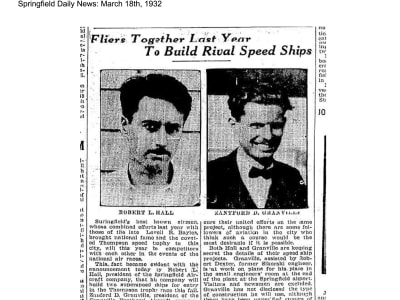
Photo shows Robert L. Hall and Zantford D. Granville, former colleagues who are now building rival speed ships at Springfield airport. Both designers worked together on the Gee Bee racers before Hall started his own company to build a gull-wing Thompson Trophy contender.
Title: Hall and Granville Announced as Rivals, Keywords: Building speed ships. Mentions Zantford Granville and Robert Dexter.
June 4, 1932
1932
Springfield Daily Republican

Russell Thaw arrives on a 'mystery visit' to Bowles Agawam airport. Frank Lynch's ship is nearing completion and will be ready for test flights within 10 days. Work is also starting on the Thompson Trophy plane that Hall himself plans to fly, expected to exceed 300 mph.
Title: Russell Thaw Visits on 'Mystery Trip', Keywords: Frank Lynch ship nearing completion. Mentions Nate C. Browne.
June 9, 1932
1932
Springfield Republican
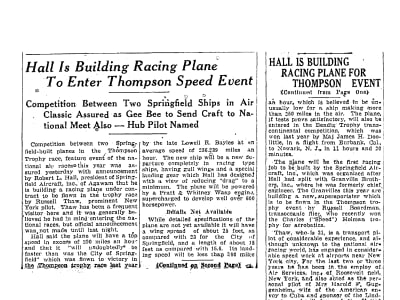
Hall is building a racing plane for the Thompson Trophy event, ensuring competition between two Springfield-built planes as the Gee Bee will also enter. Russell Thaw is named as pilot. The gull-wing plane will have a top speed over 290 mph with a Pratt & Whitney Wasp engine producing over 600 horsepower.
Title: Hall Building Racing Plane for Thompson, Keywords: Competition with Gee Bee assured. Specifications: 290+ mph target, 25 ft wingspan, 18 ft length, P&W Wasp 600+ hp.
August 2, 1932
1932
Springfield Republican
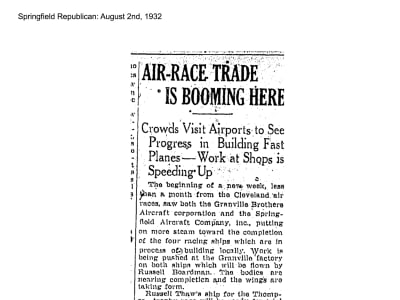
Air-race trade is booming in Springfield with both Granville Brothers and Springfield Aircraft Company racing to complete four racing ships. Russell Thaw's ship for the Thompson Trophy race will be ready for trial flights by August 15th. Crowds are visiting local airports daily to watch the progress.
Title: Air-Race Trade Booming, Keywords: Thaw ship ready for trial by August 15. Mentions Bill Hermann.
August 4, 1932
1932
Springfield Republican
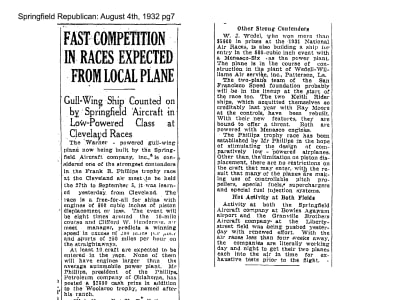
Fast competition is expected from the local gull-wing ship being built by Springfield Aircraft for the Frank R. Phillips trophy race in Cleveland. The plane is considered one of the strongest contenders. Officials have high hopes but make no predictions about the outcome.
Title: Fast Competition Expected in Phillips Trophy, Keywords: Local plane entry. Mentions Bob Hall and Frank Lynch.
August 8, 1932
1932
Springfield Union
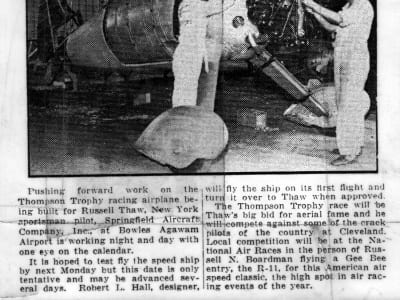
Workers rush to complete the Thompson Trophy racing airplane being built for Russell Thaw at Springfield Aircraft Company. The ship will be test flown by Robert L. Hall, its designer, to work out any kinks before being turned over to Thaw. Local competition will come from Russell N. Boardman flying a Gee Bee entry.
Title: Rush Work on Trophy Plane That Will Fly in Cleveland, Keywords: Construction progress report.
August 12, 1932
1932
Springfield Republican
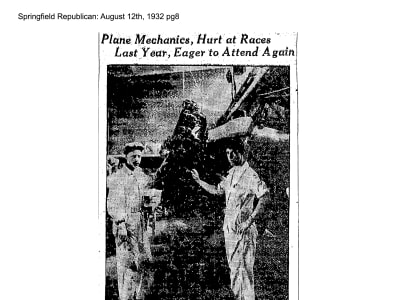
Photo shows mechanics Nelson Lundgren and Harry Jones working on Bob Hall's gull-wing racer at Bowles Agawam airport. Both mechanics were injured at last year's races but are eager to return. Hall intends to make time on pylon turns impossible to beat at the Cleveland races.
Title: Mechanics Working on Final Preparations, Keywords: Nelson Lundgren and Harry Jones helping Bob Hall with final preparations.
August 15, 1932
1932
Springfield Republican
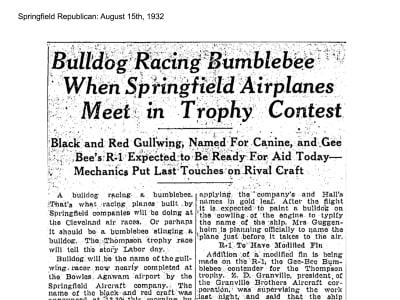
The black and red gull-wing racer has been officially named 'Bulldog' after a canine companion. Mrs. Harry F. Guggenheim flew in from New York with Russell Thaw to view the nearly completed ship at Bowles Agawam airport. The Gee Bee R-1 is also expected to be ready for testing today.
Title: Bulldog Racing Bumblebee, Keywords: Black and red gull-wing named 'Bulldog' nearly completed. First public mention of the aircraft's name. Mrs. Guggenheim backing confirmed.
August 16, 1932
1932
Springfield Republican
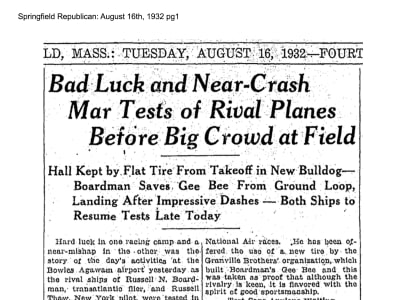
Bad luck and a near-crash mar test flights of rival planes before a large crowd. The Bulldog was kept from takeoff by a flat tire, while Russell Boardman saved the Gee Bee from a ground loop after an impressive dash. Both ships plan to resume tests later today.
Title: Bad Luck and Near-Crash Mar Tests, Keywords: Hall kept by flat tire. Mentions Russell Boardman. Target speed: 275-280 mph.
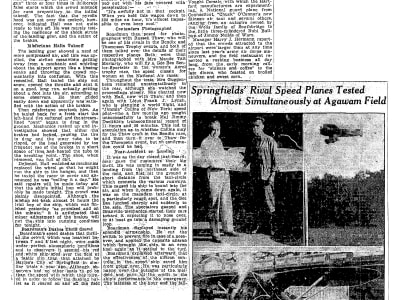
Springfield's rival speed planes were tested almost simultaneously at Agawam Field. Photo shows Russell N. Boardman, transatlantic flier who will pilot the Gee Bee, and Russell W. Thaw with a sketch of the Hall Bulldog plane he plans to fly in the Cleveland races.
Title: Bulldog and Gee Bee Tested Simultaneously, Keywords: Both aircraft tested almost simultaneously at Agawam. Mentions Lee Gehlbach.
August 17, 1932
1932
Springfield Republican
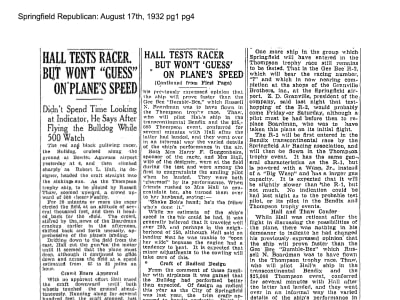
Hall tests his racer but won't 'guess' on the plane's speed. He didn't spend time looking at the indicator during test flights. The ship uses radical design innovations including special landing gear developed by Hall. Mrs. Harry F. Guggenheim has declared herself 'charmed' by the Bulldog's performance.
Title: Hall Tests Racer But Won't Guess on Speed, Keywords: Indicates 500 mph may be possible in future aircraft. Target speed: 280+ mph.
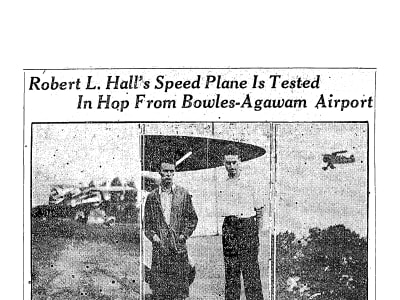
Robert L. Hall's speed plane 'The Bulldog' is flight-tested at Bowles-Agawam Airport. Photo shows the ship taking off on its initial flight which proved a success. Also pictured: Russell Thaw, the youthful New York flier who will pilot the plane in Cleveland, and Robert L. Hall, its designer.
Title: Hall Speedplane Tested in Hop from Bowles-Agawam, Keywords: Photo page showing Russell Thaw and Bob Hall.
August 18, 1932
1932
Boston Globe
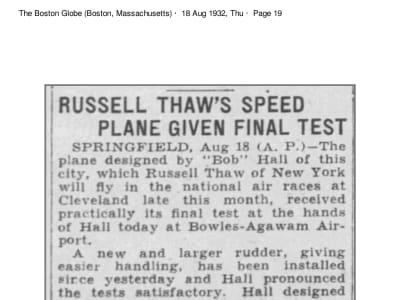
Russell Thaw's speed plane receives its final test at Bowles-Agawam Airport. A new and larger rudder has been installed for easier handling, and Hall pronounced the tests satisfactory. Hall previously designed the 'City of Springfield' which Lowell R. Bayles flew to victory in last year's Thompson Trophy race.
Title: Thaw Speed Plane Given Final Test, Keywords: New larger rudder installed.
August 21, 1932
1932
Springfield Republican
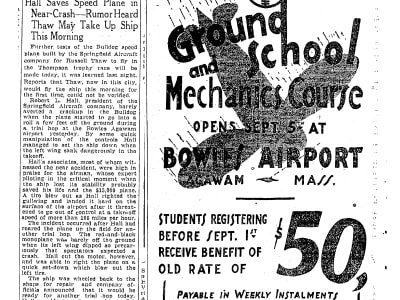
The Bulldog is scheduled for a test hop today following Hall's near-crash. Rumors circulate that Thaw may take up the ship this morning. Associates at Springfield Aircraft were high in their praise for the airplane, noting its stability could save a life even when landing gear and propeller are damaged.
Title: Bulldog to Go Up in Test Hop Today, Keywords: Near-crash from tire blowout. Mentions Jimmie Collins. Takeoff speed: 160+ mph.
August 22, 1932
1932
Springfield Republican
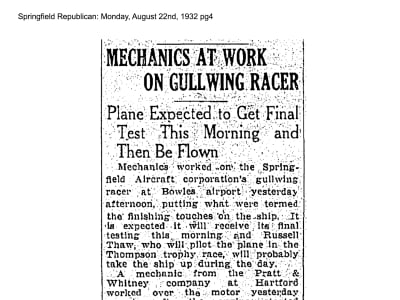
Mechanics work on the gull-wing racer putting finishing touches on the ship. Final testing is expected this morning with Russell Thaw piloting the plane in the Thompson Trophy race. A Pratt & Whitney mechanic worked on the motor after it started spurting oil. Streamlining and final painting completed.
Title: Mechanics at Work on Gull-Wing Racer, Keywords: P&W mechanic worked on motor.
August 23, 1932
1932
Springfield Republican
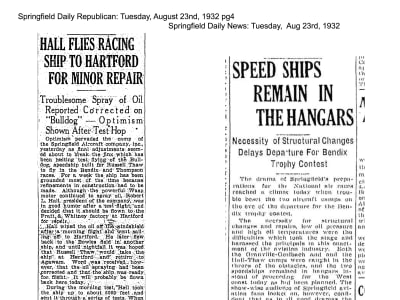
Hall flies the Bulldog to Hartford for repairs, where the troublesome oil spray problem is corrected. A subsequent test hop leaves the team optimistic about the aircraft's performance heading into the races.
Title: Hall Flies to Hartford for Minor Repair, Keywords: Oil spray corrected. Mentions Edmund Guggenheim. Speed: 260+ mph achieved.
August 24, 1932
1932
Springfield Republican
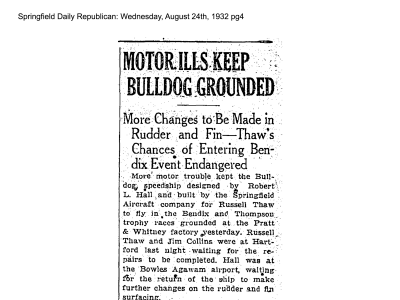
Motor troubles keep the Bulldog grounded as more changes need to be made to the rudder and fin. Russell Thaw and Jim Collins were at Hartford waiting for repairs at the Pratt & Whitney factory. Thaw's chances of entering the Bendix event are endangered by the necessary last-minute changes.
Title: Motor Ills Keep Bulldog Grounded, Keywords: Thaw Bendix chances endangered. Mentions Frank Lynch.
August 25, 1932
1932
Springfield Republican
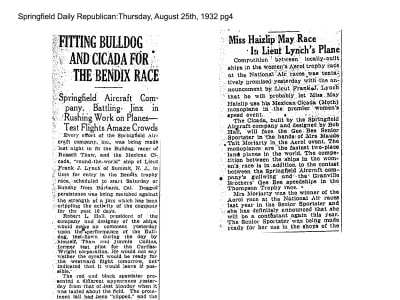
Springfield Aircraft Company battles a jinx while rushing work on both the Bulldog racer and the Mexican Cicada. Test flights amaze crowds as Thaw took the racer aloft and put it through test maneuvers. The prominent tail has been 'clipped' and the fin enlarged to make almost a straight line from cockpit hood to tail top.
Title: Fitting Bulldog and Cicada for Bendix, Keywords: Tail clipped, fin enlarged. Mentions Jimmie Collins and May Haizlip.
August 26, 1932
1932
Boston Globe
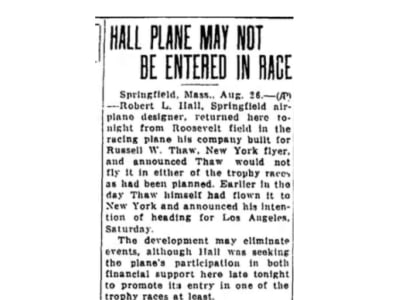
Hall plane may not be entered in the race. Robert L. Hall returned to Springfield from Roosevelt Field announcing that Russell Thaw would not fly in either trophy race as planned. Thaw had flown to New York announcing his intention to head for Los Angeles. Hall was seeking financial support to promote the plane's entry.
Title: Hall Plane May Not Be Entered in Race, Keywords: Thaw won't fly it.
Springfield Republican
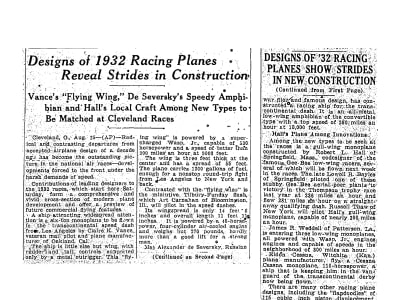
Designs of 1932 racing planes reveal strides in construction. Among the new types to be seen at the races is the gull-wing monoplane constructed by Robert L. Hall of Springfield. The late Lowell R. Bayles piloted one of Hall's Gee Bee designs to victory in the 1931 Thompson Trophy race at 236 mph.
Title: Designs of 1932 Racing Planes Reveal Strides, Keywords: Strides in construction. Mentions Lowell Bayles. Target speed: 300+ mph.
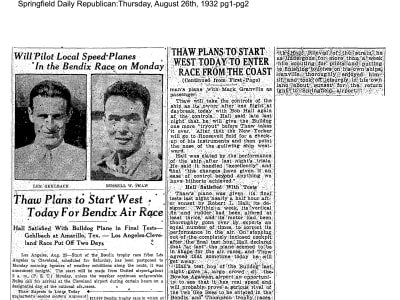
Thaw plans to start west today to enter the race from the coast. Photos show Lee Gehlbach and Russell W. Thaw. Hall is satisfied with the Bulldog's performance in final tests. The plane made impressive speed runs at Gallaudet, Annapolis. Plans remain tentative due to last-minute complications.
Title: Thaw Plans to Start West for Bendix, Keywords: Photos of Gehlbach and Thaw. Speed: 245.709 mph maximum recorded.
August 27, 1932 — THE CRISIS
1932
Springfield Republican
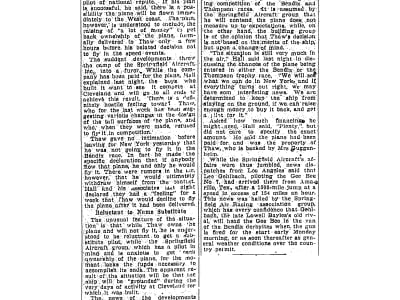
Thaw refuses to fly the plane unless it is repurchased. The central feature of the situation is that while Thaw owns the plane and will not fly it, Hall has no plane but is eager to race. Thaw says he would buy another ship if he could sell the Bulldog. The arrangement with Mrs. Guggenheim and Hall reached an impasse.
Title: THAW REFUSES TO FLY PLANE, Keywords: Says gull-wing 'not suited for racing.' A devastating blow just days before the Cleveland races. Mentions Jimmie Collins.
August 28, 1932 — Hall Takes the Controls
1932
Miami News-Record
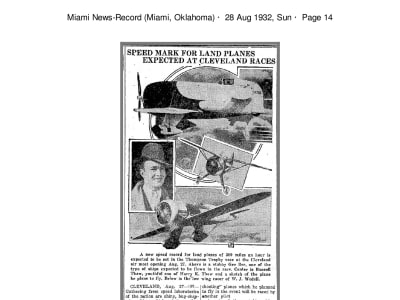
A new speed record for land planes of 300+ mph is expected at the Thompson Trophy race opening August 27 in Cleveland. Photos show a stubby Gee Bee, Russell Thaw with a sketch of the gull-wing plane he plans to fly, and a low-wing racer. More than 40 special racing planes have been built for the 80-odd events.
Title: Speed Mark for Land Planes Expected at Cleveland, Keywords: Photos of Gee Bee. Mentions Jimmy Doolittle and Lowell Bayles.
Springfield Daily News
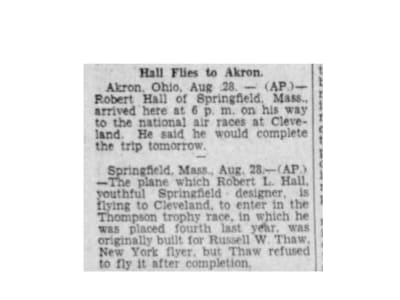
Hall flies to Akron on his way to the national air races at Cleveland. The plane, originally built for Russell W. Thaw who refused to fly it after completion, is now being flown by Hall himself for the Thompson Trophy race where he placed fourth last year.
Title: Hall Flies to Akron, Keywords: Plane built for Thaw who refused to fly.
Springfield Union Republican

Hall will hop off for the air races in the Bulldog today. President of Springfield Aircraft Company will fly the speed plane for Mrs. Guggenheim, who is still on friendly terms with Hall but had difficulty over the sponsorship arrangement. Thaw declined to fly and returned to New York, saying he didn't want 'second-hand glory.'
Title: Hall to Hop Off for Races in Bulldog, Keywords: Mrs. Guggenheim backing confirmed. William Hermann mentioned.
August 29, 1932
1932
Springfield Republican
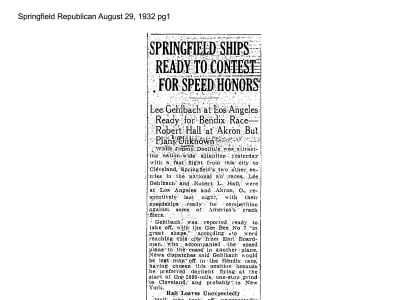
Springfield ships are ready to contest for speed honors. Lee Gehlbach is at Los Angeles ready for the Bendix race while Robert Hall is at Akron with plans unknown. Hall took off unexpectedly from Roosevelt Field after learning Thaw would not fly. Hall's arrival at Akron was reported to associates at Bowles-Agawam Airport.
Title: Springfield Ships Ready for Speed Honors, Keywords: Hall at Akron. Mentions Lee Gehlbach and Jimmy Doolittle.
August 31, 1932 — Qualifying at Cleveland
1932
Boston Globe
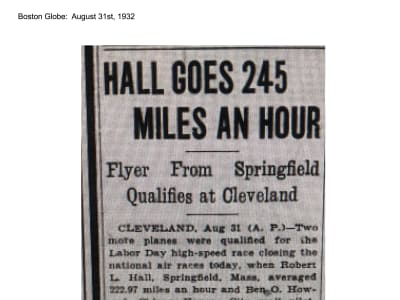
Hall goes 245 miles an hour! The flyer from Springfield qualifies at Cleveland, averaging 222.97 mph with Ben O. Howard at 213.85 mph. Hall, flying his gull-wing monoplane of his own design, reached a maximum of 245.79 mph on one dash but was forced to cut speed when the streamlined cowling came loose.
Title: Hall Goes 245 Miles an Hour, Keywords: Qualifies at Cleveland. Speed: 245.709 mph maximum, 222.97 mph average. Mentions Ben Howard.
Spokane Chronicle
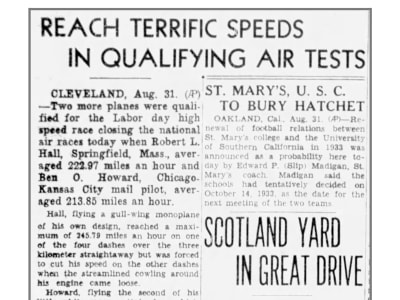
Terrific speeds reached in qualifying air tests at Cleveland. Robert L. Hall of Springfield, Mass. averaged 222.97 mph while flying his gull-wing monoplane. His fastest time was 245.79 mph on one of the four dashes, but he was forced to cut speed when the cowling around his engine came loose.
Title: Reach Terrific Speeds in Qualifying Air Tests, Keywords: Hall qualifies at 245.79 mph maximum. Mentions Ben Howard.
September 1, 1932
1932
Flying Magazine
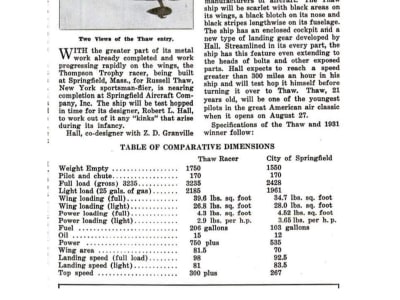
From the August/September 1932 issue of Flying Magazine. Feature article on Russell Thaw's new Thompson Trophy racer. Hall, co-designer with Z.D. Granville of the 1931 winner 'City of Springfield,' worked for six months on the Thaw ship. The scarlet plane with black areas features an enclosed cockpit and new landing gear. Specifications compare the Thaw Racer to the City of Springfield: top speed 300+ mph vs 267 mph.
Title: Russell Thaw's New Thompson Trophy Racer, Keywords: Specifications table: 1,750 lbs, 750+ hp, 81.5 sq ft wing area, 300+ mph target.
September 1, 1932
1932
Springfield Republican
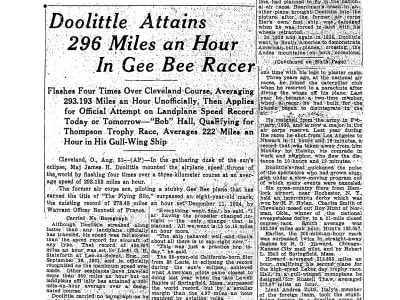
Doolittle attains 296 miles an hour in the Gee Bee racer. In the gathering dusk of the early evening, the famous pilot flashed around the world four times on a three-kilometer course. Meanwhile, Hall of Springfield averaged 222 mph in his gull-wing ship, qualifying for the Thompson Trophy race.
Title: Doolittle Attains 296 mph in Gee Bee, Keywords: Hall qualifying at 222 mph.
September 2, 1932
1932
Daily Times (Ohio)
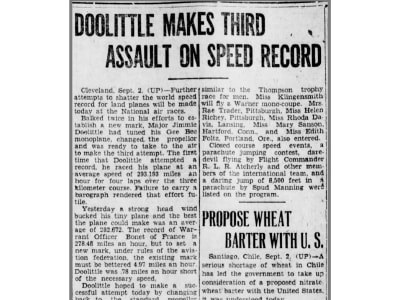
Doolittle makes third assault on speed record. Three famous airmen vie with Doolittle in record-breaking attempts: Robert L. Hall of Springfield, Mass. filed application with the contest committee for a world record in his gull-wing monoplane, along with Jimmie Wedell and Jimmie Haizlip.
Title: Doolittle Makes Third Assault on Speed Record, Keywords: Hall filed application. Mentions Jimmie Wedell.
September 3, 1932
1932
Baltimore Sun
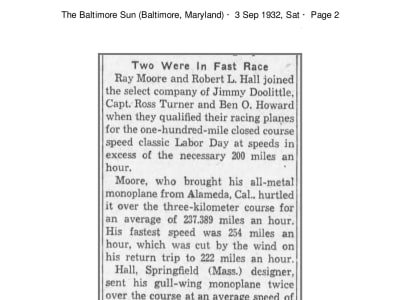
Two pilots qualify for the fast race. Ray Moore and Robert L. Hall joined the select company of Jimmy Doolittle, Capt. Ross Turner and Ben O. Howard. Hall sent his gull-wing monoplane twice over the course at an average of 254.563 mph, with his fastest time downwind being 271 mph.
Title: Hall Sends Gull-Wing Over Course at 254.563 mph, Keywords: 271 mph downwind peak. Mentions Ray Moore.
Spokesman-Review

Planes collide banking at a pylon, sending two pilots plunging 150 feet to the hospital. Neither pilot died. Meanwhile in the Thompson Trophy qualifying, Hall of Springfield sent his gull-wing monoplane twice over the course at 254.563 mph average, with a fastest time of 271 mph downwind.
Title: Planes Collide Banking Pylon, Keywords: Hall does 254 mph average.
September 4, 1932
1932
Springfield Republican
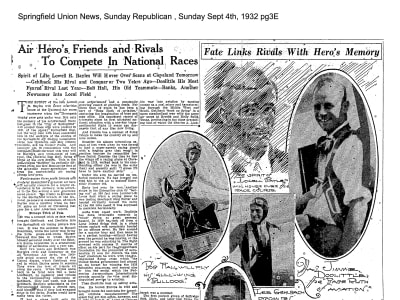
Air hero's friends and rivals compete in national races. The spirit of the late Lowell R. Bayles hovers over the scene at Cleveland tomorrow. Photos show Jimmy Doolittle and the Gee Bee, Lee Gehlbach with the Gee Bee 'Sportster,' and Jimmy Wedell, all competing against Bob Hall in the Bulldog.
Title: Air Heroes, Friends and Rivals to Compete, Keywords: Spirit of Lowell Bayles. Mentions Jimmy Doolittle and Lee Gehlbach.
September 6, 1932 — Thompson Trophy Results
1932
Springfield Republican
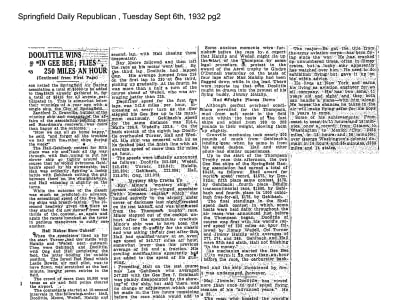
Doolittle wins the Gee Bee, flies 250 miles an hour! He roared around the Springfield Air Patrol course and smashed all previous records. Hall's Bulldog mysteriously cracked up in the Thompson race during the third lap and landed safely on the infield, though the cause of the crash was unclear.
Title: Doolittle Wins in Gee Bee at 252 mph, Keywords: Hall finishes sixth in Thompson Trophy at 211.47 mph. Mentions Lee Gehlbach.
January 1, 1933 — Year in Review
1933
Springfield Republican
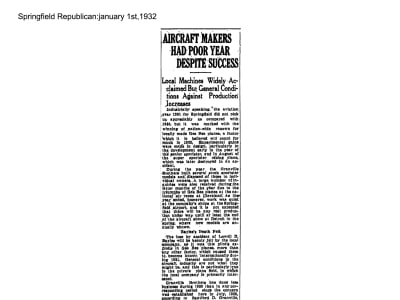
Aircraft makers had a poor year despite success. Local machines were widely acclaimed but general conditions worked against production increases. The loss of Lowell R. Bayles was keenly felt by the local company. Robert L. Hall, former chief engineer of Granville Brothers, may bring the Springfield Aircraft company into prominence.
Title: Aircraft Makers Had Poor Year Despite Success, Keywords: Hall may bring new idea. Mentions Lowell Bayles and Zantford Granville.
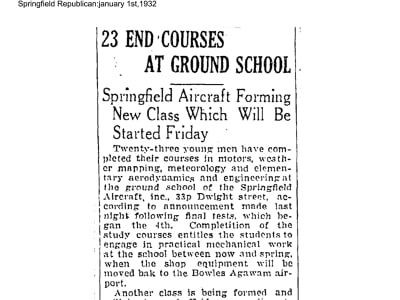
Twenty-three young men completed courses in motors, weather mapping, meteorology and elementary aerodynamics at the ground school of Springfield Aircraft. The course entitles students to engage in practical mechanical work at the school, which will move back to Bowles Agawam airport when shop equipment is transferred.
Title: 23 End Courses at Ground School, Keywords: New class forming. Mentions William Hermann.
February 27, 1991 — Retrospective
1991
Morning Call

Aviation pioneer Robert L. Hall dies at age 85. Hall got his start designing Gee Bee racers and went on to design jets for Grumman. His Gee Bee Model Z 'City of Springfield' won the Thompson Trophy in 1931, and pilot Lowell Bayles set an air speed record of 296.2 mph. Hall later joined Grumman, designing the F4F Wildcat, F6 Hellcat, F8F Bearcat, and F7F Tigercat.
Title: Aviation Pioneer Robert L. Hall Dies at 85, Keywords: Obituary. Career highlights: Gee Bee Z design, Grumman F4F/F6F/F8F/F7F fighters, Gulfstream I. Inducted into Aviation Hall of Fame in 1990.
Help Us Identify These Photos
We haven't been able to determine the exact dates for these photos. If you recognize any details that could help place these photos in the timeline—perhaps from other period photographs, newspaper coverage, or historical records—we'd love to hear from you.
Contact us with information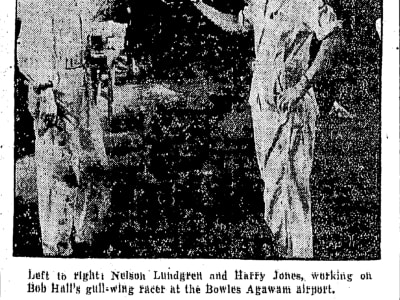
Photo shows mechanics Nelson Lundgren and Harry Jones working on Bob Hall's gull-wing racer at the Bowles Agawam airport. Both men were hurt at races last year but are eager to attend again. This appears to be the same photo from the August 12, 1932 Springfield Republican article.
Title: Mechanics Working on Gull-Wing Racer, Keywords: Photo of Nelson Lundgren and Harry Jones working on the aircraft.
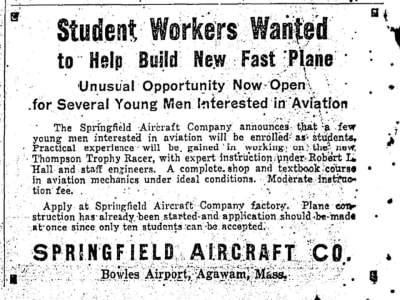
Advertisement from Springfield Aircraft Company seeking student workers to help build new fast planes. Young men interested in aviation can enroll as students and gain practical experience working on the Thompson Trophy racer under Robert L. Hall and staff engineers. Only ten students can be accepted.
Title: Springfield Aircraft Co. Advertisement, Keywords: Seeking student workers at Bowles Airport, Agawam. Maximum 10 students.
The Story As It Unfolded
Reading these clippings in sequence reveals a story that even Hollywood would find hard to improve upon. What emerges from the newsprint is not just the history of an aircraft, but a portrait of golden age air racing at its most dramatic.
A Designer Strikes Out on His Own
The story begins in November 1931, when the Springfield papers announced that Bob Hall—the brilliant young engineer who had designed the Gee Bee Z for the Granville Brothers—was leaving to start his own company. Hall had helped create one of the fastest aircraft in the world, but a disagreement with the Granvilles sent him across the Connecticut River to Bowles-Agawam Airport.
The local press was enthusiastic. Here was a chance for Springfield to have not one but two racing plane manufacturers. The papers noted Hall’s ambition to build a “speedship” in the spirit of the late Lowell Bayles, the Gee Bee pilot who had died setting a world speed record just weeks earlier.
Building the Bulldog
Through the winter and spring of 1932, the clippings track the Bulldog’s progress from paper to reality. January brought news that a full-scale model was nearly complete. By February, the papers reported that Russell Thaw—son of the infamous Harry K. Thaw—had commissioned the aircraft for the Thompson Trophy Race, with backing from Mrs. Marion Price Guggenheim.
The specifications grew more impressive with each article. Early reports mentioned a 185 mph target; by June, Hall was promising 290 mph or more. The gull-wing design—Hall’s signature innovation—drew particular attention. Reporters marveled at the compact fuselage, the enclosed cockpit, and the massive Pratt & Whitney Wasp engine that would power it all.
August: Triumph and Crisis
August 1932 was the most intense month in the Bulldog’s brief history, and the newspaper coverage reflects the chaos. The first test flight on August 15 made headlines, but so did the near-disasters that followed: tire blowouts, engine troubles, and frantic modifications to the tail section.
The clippings from this period read like a thriller. On August 16, a flat tire nearly caused a crash during testing. On August 21, another tire blowout threatened disaster. On August 23, Hall flew to Hartford for emergency repairs at the Pratt & Whitney factory. The Bendix transcontinental race—which Thaw had hoped to enter—came and went while the team struggled with mechanical problems.
Then came the bombshell. On August 27, the Springfield Republican reported that Russell Thaw had refused to fly the Bulldog, calling the gull-wing design “not suited for racing.” After months of preparation and thousands of dollars invested, the aircraft’s intended pilot had walked away.
Hall Takes the Controls
What happened next defines the Hall Bulldog legend. Rather than abandon the project, Bob Hall announced he would fly the aircraft himself. The next day’s papers reported his departure for Cleveland, with Mrs. Guggenheim’s continued backing.
The clippings from Cleveland tell of a designer turned racing pilot, pushing his own creation to its limits. Hall qualified at over 245 mph—with one dash hitting nearly 246 mph. In a pre-race test, he averaged 254.563 mph, with a peak of 271 mph on the downwind leg.
The Thompson Trophy
On September 5, 1932, Hall lined up against some of the greatest names in aviation: Jimmy Doolittle in the Gee Bee R-1, Lee Gehlbach, Roscoe Turner, and Jimmy Wedell. The Springfield Republican—which had followed every twist of the story—reported the results the next day: Doolittle won at 252 mph, while Hall finished sixth at 211.47 mph.
It wasn’t victory, but it was vindication. The aircraft that Thaw had called unsuitable for racing had completed the Thompson Trophy course. Hall had proven his design—and his courage.
Key Themes in the Coverage
Local Pride
The Springfield papers were unabashedly proud of their hometown aircraft manufacturer. Headlines celebrated “Springfield ships” and “local planes” competing against the nation’s best. The rivalry with the Granville Brothers—also based in Springfield—added extra spice to the coverage.
The Danger of Speed
These clippings are haunted by death. Lowell Bayles, who had set a world speed record in the Gee Bee Z, was killed in December 1931—his memory invoked repeatedly in coverage of the new racing season. The reporters understood they were covering a deadly sport; every article about speed records carried an undercurrent of risk.
Technical Innovation
The press gave detailed attention to the Bulldog’s technical features: the gull wing, the controllable-pitch propeller, the enclosed cockpit, the evolving tail configurations. Reporters interviewed Hall about aerodynamics and quoted speed estimates with precision. Aviation was still new enough that readers wanted to understand how these machines worked.
Wealth and Patronage
The coverage reveals how air racing depended on wealthy backers. Russell Thaw’s family fortune, the Guggenheim family’s support, the involvement of society figures—all of this was reported as matter-of-factly as engine specifications. Racing aircraft were expensive, and the press made no secret of where the money came from.
The Human Drama
Above all, these clippings tell a human story. Hall’s determination after Thaw’s abandonment, the mechanics working through the night, the reporters speculating on whether the aircraft would even make it to Cleveland—all of it reads like a drama playing out in real time. The journalists covering the story had no idea how it would end, and that uncertainty infuses every dispatch.
Key Facts from the Coverage
Speed Records
- Qualifying speed: 222.97 mph (August 31)
- Peak qualifying speed: 245.709 mph (one dash)
- Pre-race test speed: 254.563 mph average, 271 mph downwind peak (September 2)
- Thompson Trophy race: 6th place, 211.47 mph average (September 5)
Timeline Highlights
- November 1931: Hall leaves Granville Brothers, joins Baltrun Flying School
- January-June 1932: Bulldog design
- August 15, 1932: Build deadline. Flat tire on taxi test.
- August 16, 1932: First flight
- August 20, 1932: Near crash on take-off
- August 22, 1932: Flown to Hartford Pratt & Whitney for repairs
- August 26-27, 1932: Thaw announces he won’t fly the plane
- August 28, 1932: Hall departs for Cleveland
- August 31, 1932: Qualifying runs at Cleveland
- September 5, 1932: Thompson Trophy Race — 6th place
Key People
- Designer/Pilot: Robert L. “Bob” Hall
- Original Commissioner: Russell W. Thaw (declined to fly)
- Financial Backer: Mrs. Marion Price Guggenheim
- Mechanics: Nelson Lundgren, Harry Jones
- Competitors: Jimmy Doolittle, Lee Gehlbach, Roscoe Turner, Jimmy Haizlip, Ben O. Howard, William Ong
See also: Hall Bulldog Photo Timeline for a collection of period photographs documenting the aircraft’s development and racing career.
