Russian Thunder
Yakovlev Yak-54
My first aerobatic airplane (2012-2013)

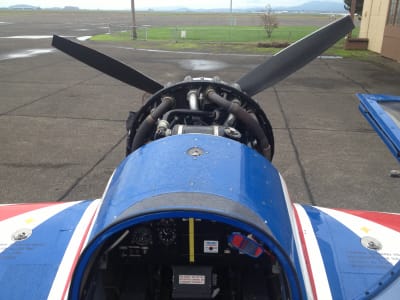
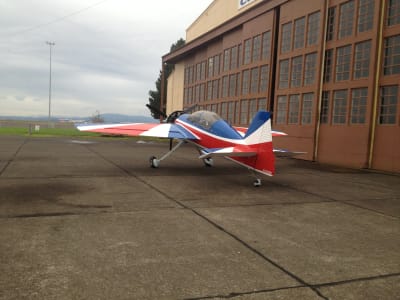
Russian Thunder was my first experience with aerobatic airplane ownership. This two-seat, all-metal aircraft features lots of titanium construction and is powered by a Vedeneyev M-14 radial engine spinning a big custom three-bladed MT propeller.
I purchased this aircraft from the estate of Eric Beard, an airshow pilot who passed away. The aircraft had been on the market for some time when I approached his widow. I flew down to Tucson to meet with her and negotiate. That trip to Arizona stuck with me, and I eventually decided to move to Scottsdale to enjoy the desert scenery and beautiful sunny weather. "We get 360 flying days a year," they told me, and it's true.
The RealFlight Connection
What got me interested in this plane is that we used it on the cover of RealFlight for many years. At one point, the marketing folks at Hobbico wanted to show off the damage modeling in our simulation product, so they used a picture in the ads with a wing breaking off of the Yak-54 model.
I got a call from Eric's wife asking if we could please change the aircraft we used because she and her husband picked up their copy of Model Airplane News and saw a picture of Eric's plane with a wing missing—and it scared them! We agreed, naturally, and it started me thinking: if I can fly a model airplane aerobatically, why don't I try flying the real thing?
Learning Experience
This was a nice airplane in many ways, but performance was not up to modern standards even though when I bought it, it wasn't that old. The ailerons were the weak point, but I got some great experience with control surface design by playing around with them.
I learned a lot during those days and still use the skills I built. I had done a lot of physics simulation work, but none of it had to do with control surface forces felt by the pilot. I had to learn a lot about that later in my career as I worked on tuning the MX ailerons for MX Aircraft, so this initial set of learning opportunities helped me on the way.
It was comfortable in cross country but slow—I only got about 155 kts at 18 gph. Compare that with the MX-S which is closer to 200 kts at about 15 gph.
Aerobatically, it does everything a good aerobatic airplane can do, and I think it makes a great airshow aircraft. The sound of a radial engine is pleasant and unmistakable.
Aircraft Specifications
Dimensions
- Wingspan
- 26 ft 9 in / 8.16 m
- Length
- 23 ft 11 in / 7.29 m
- Height
- 8 ft 10 in / 2.69 m
- Construction
- All-metal with titanium
Performance
- Max Speed
- 243 kts / 450 km/h
- G Limits
- +9 / -9 g
- Range
- 340 nm / 630 km
- Service Ceiling
- 13,000 ft / 4,000 m
Engine
- Type
- Vedeneyev M-14PF
- Configuration
- 9-cylinder radial
- Power
- 360 HP / 268 kW
- Propeller
- MT 3-blade
Weights
- Empty Weight
- 1,499 lb / 680 kg
- Max Takeoff
- 2,315 lb / 1,050 kg
- Crew
- 2
- Origin
- Russia
Photo Gallery






Related Articles

Saying Goodbye to Russian Thunder
A bittersweet farewell to my first aerobatic airplane, the Yakovlev Yak-54

Russian Thunder: My First Aerobatic Airplane
The Yakovlev Yak-54 that started my journey into aerobatic airplane ownership

Flying a Giant Scale Model of Russian Thunder

I Wish He Hadn't Done That
The harrowing story of a test flight that nearly ended in disaster - engine failure, white-hot metal, and trees too close for comfort.

Zero Timing Russian Thunder
The extensive restoration that brought my Yak-54 back to factory-new condition