Notes from Premo Galletti: A Day-by-Day Account of the Hall Bulldog


Part of The Hall Bulldog Project — documenting Bob Hall's 1932 Thompson Trophy racer.
Explore the Project →Among the most valuable primary sources documenting the Hall Bulldog are these handwritten notes by Premo Galletti, who recorded the day-by-day events at Springfield Aircraft Co. during the frantic final weeks before the 1932 National Air Races.
Covering August 14–28, 1932, these 13 pages capture the drama of test flights, mechanical failures, last-minute modifications, and the stunning moment when Russell Thaw—the wealthy pilot who had commissioned the aircraft—refused to accept it, pronouncing it “a washout” and “not suited for racing.”
The document provides an intimate, ground-level view of what it was like to build a racing aircraft against an impossible deadline, and the determination of Bob Hall to fly his creation in the Thompson Trophy Race despite everything.
The Document
Download Original PDF
(7.2 MB, 13 pages)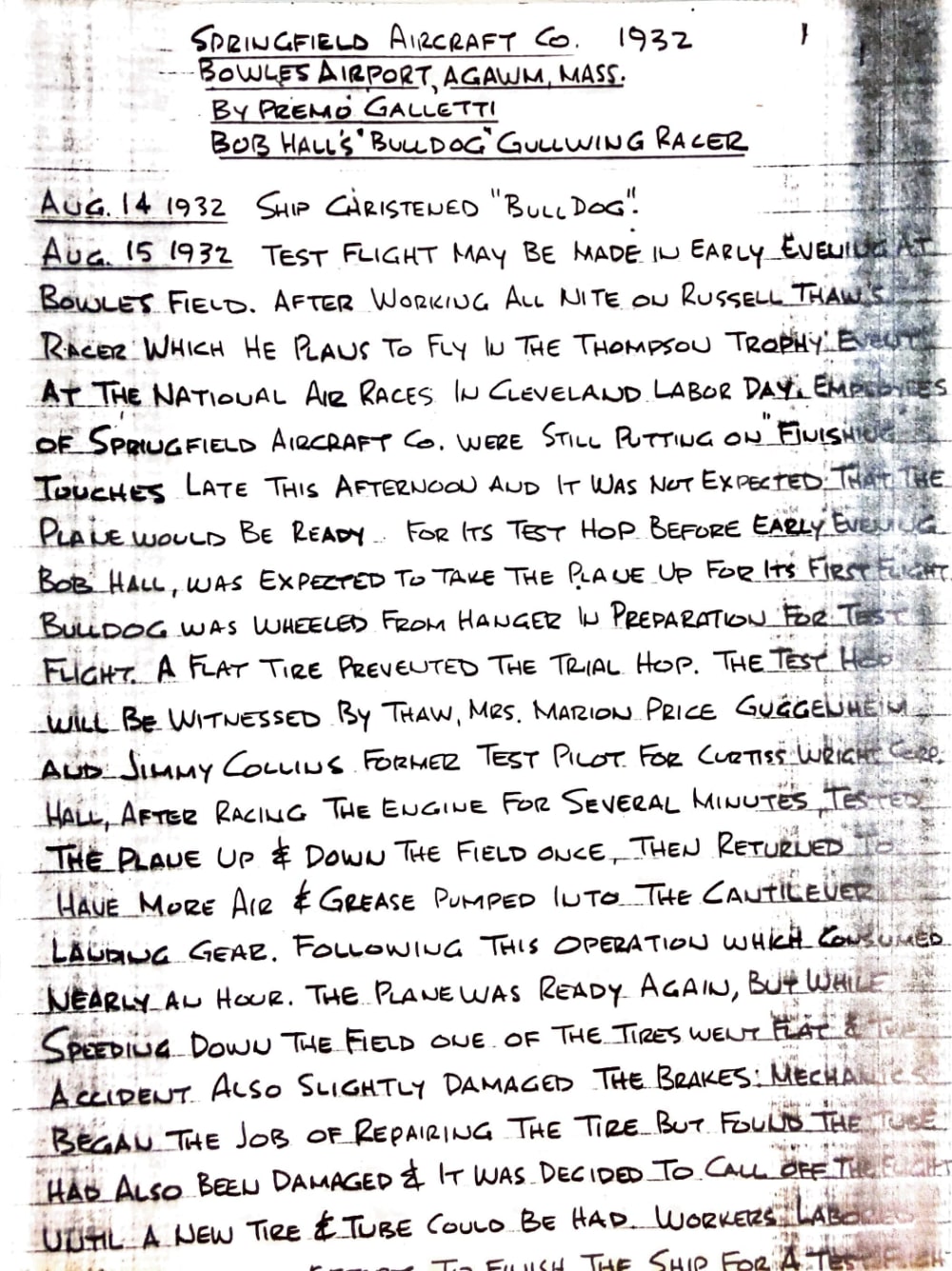
Page 1: August 14–15, 1932. Ship christened “Bulldog.” Test flight delayed by flat tire. Workers still putting finishing touches late in the afternoon.
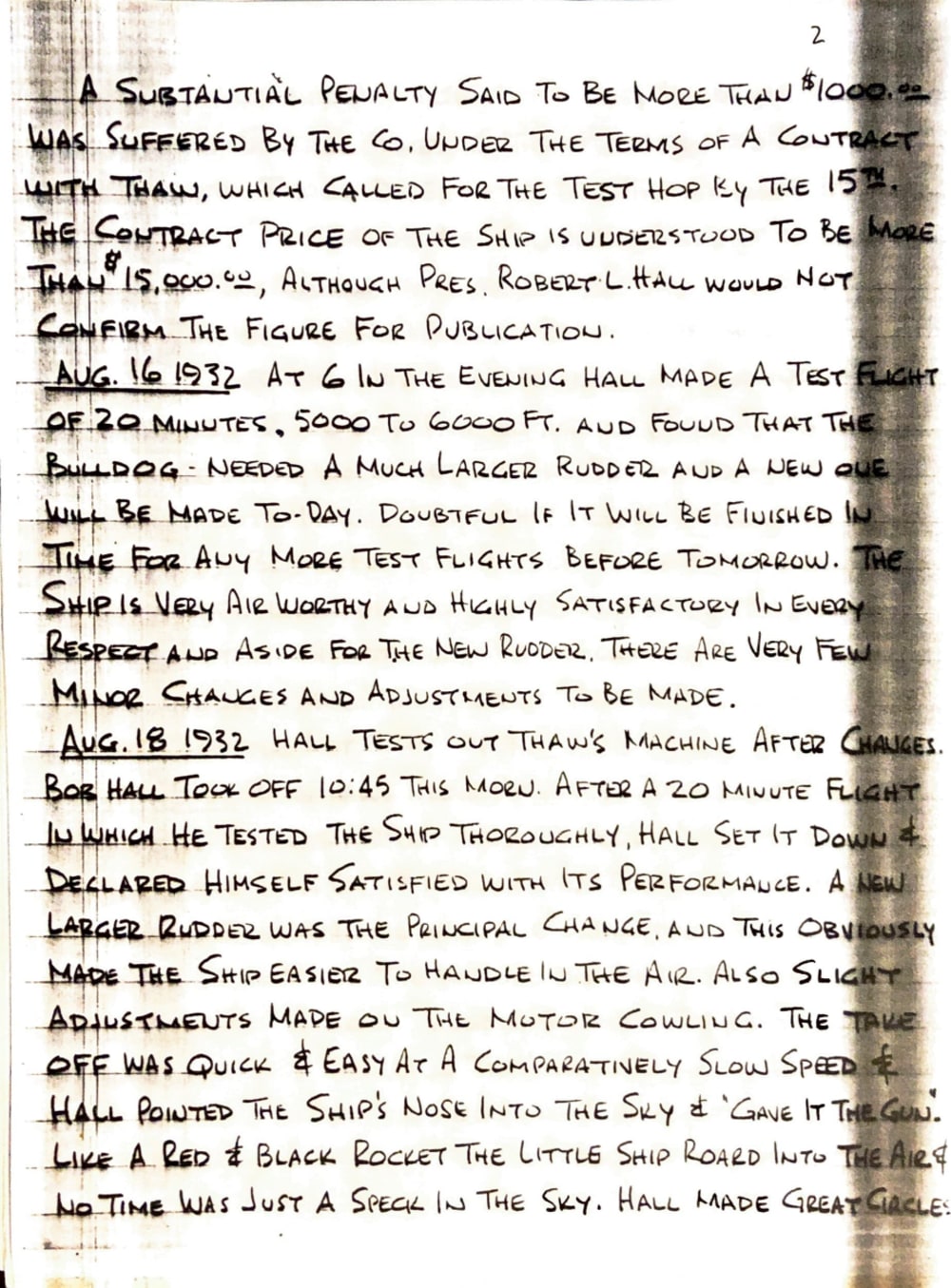
Page 2: August 16–18. Contract penalty of over $1,000 for missing deadline. First test flight reveals need for much larger rudder. Ship cost understood to be more than $15,000.
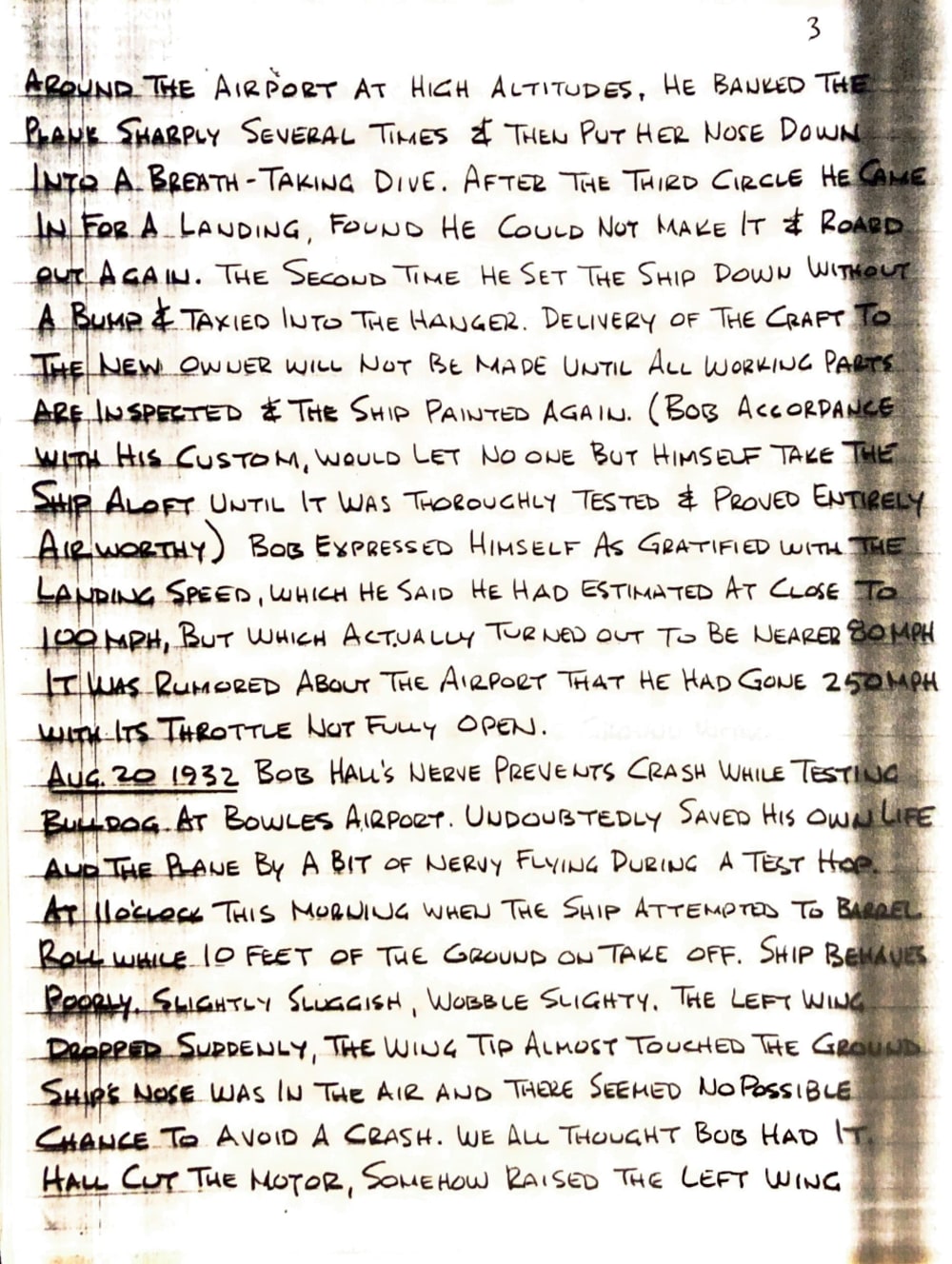
Page 3: August 18–20. Hall tests with new rudder, satisfied with performance. Delivery delayed for inspection and repainting. Hall estimated landing speed at 100 mph but it turned out to be nearer 80 mph.
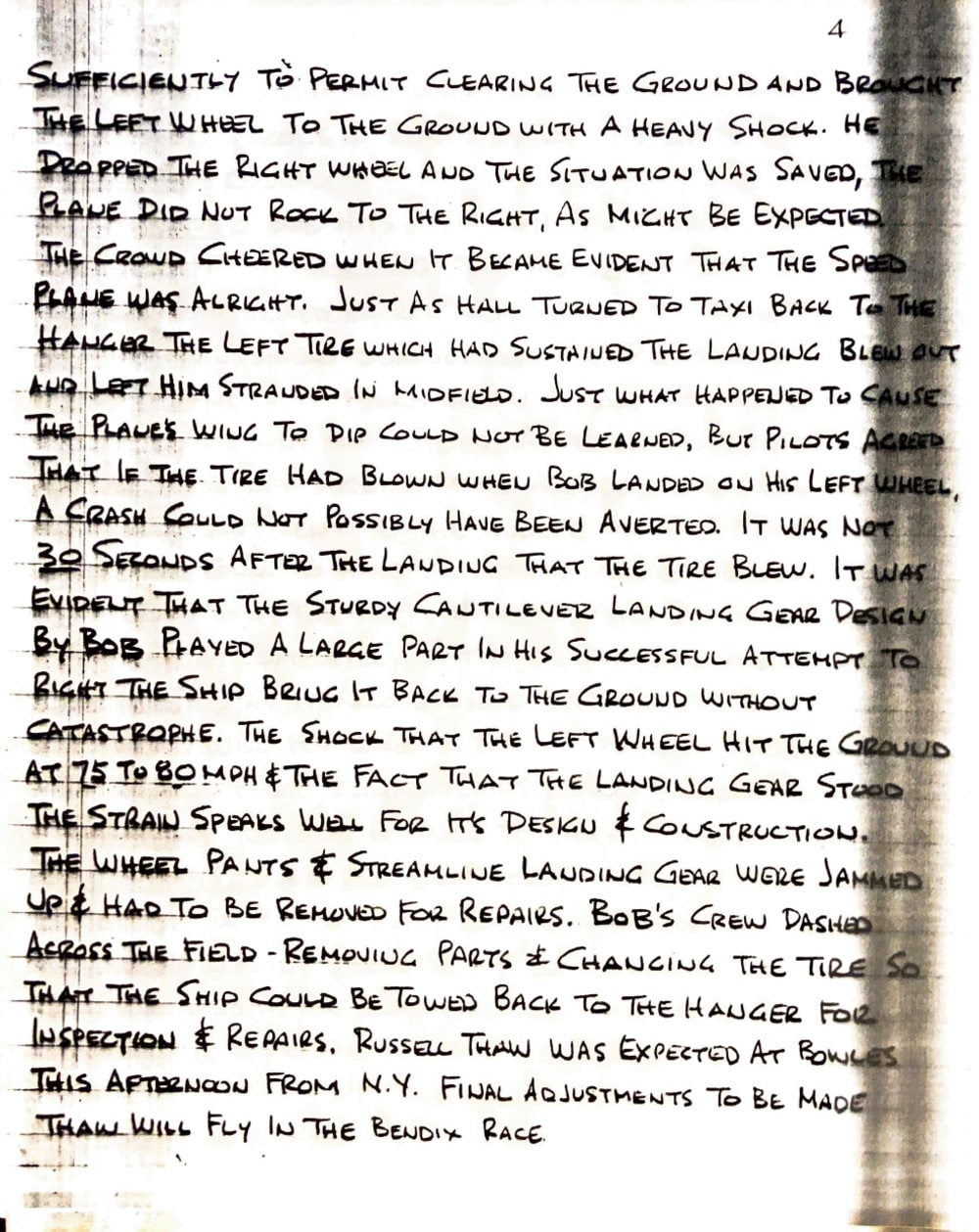
Page 4: August 20. “Bob Hall’s nerve prevents crash while testing Bulldog… The ship attempted to barrel roll while 10 feet of the ground on take off… We all thought Bob had it.” Hall’s skill and the sturdy landing gear save the day.
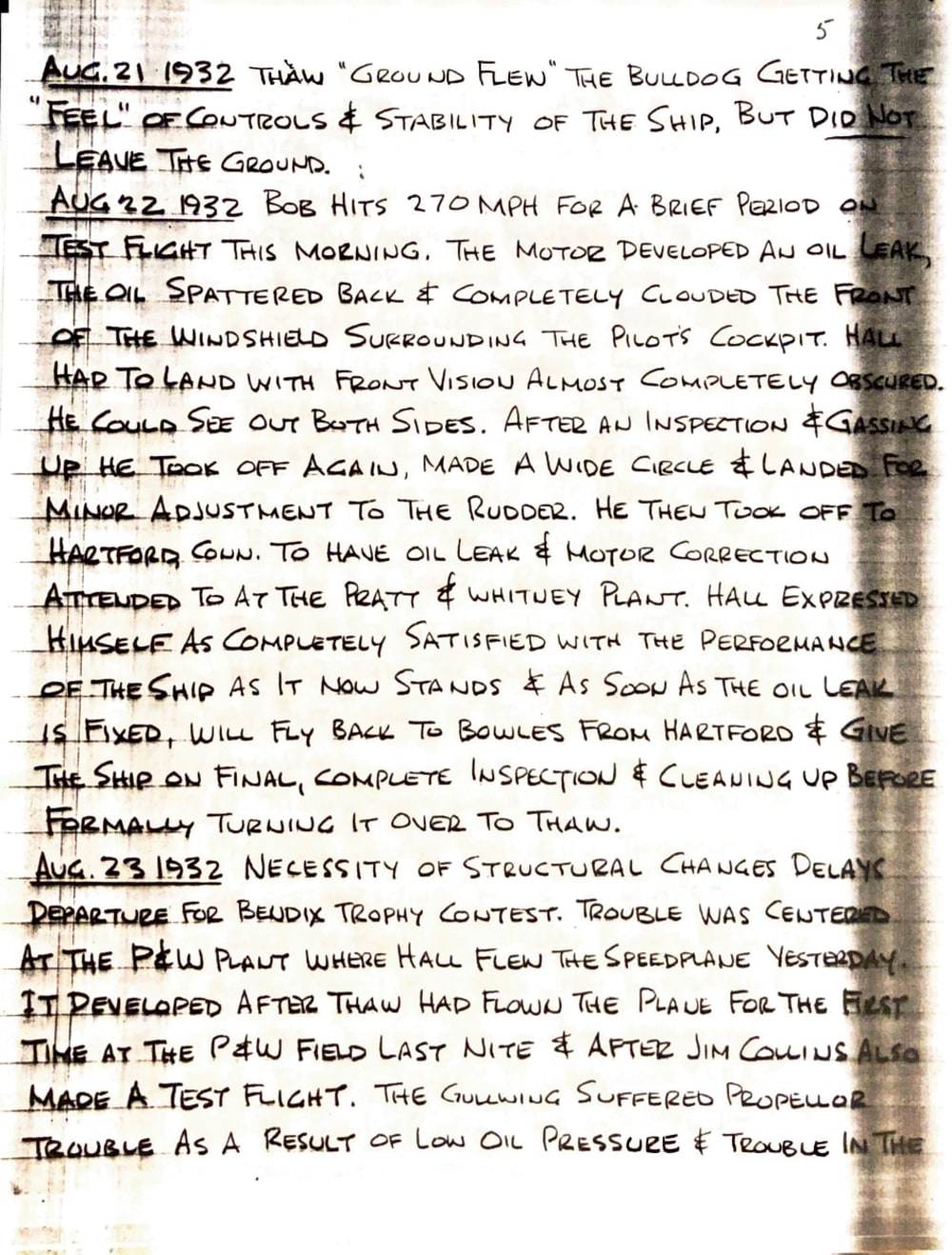
Page 5: August 21–22. Thaw “ground flew” the Bulldog to get the feel of the controls. Bob hits 270 mph on test flight but motor develops oil leak that clouds the windshield.
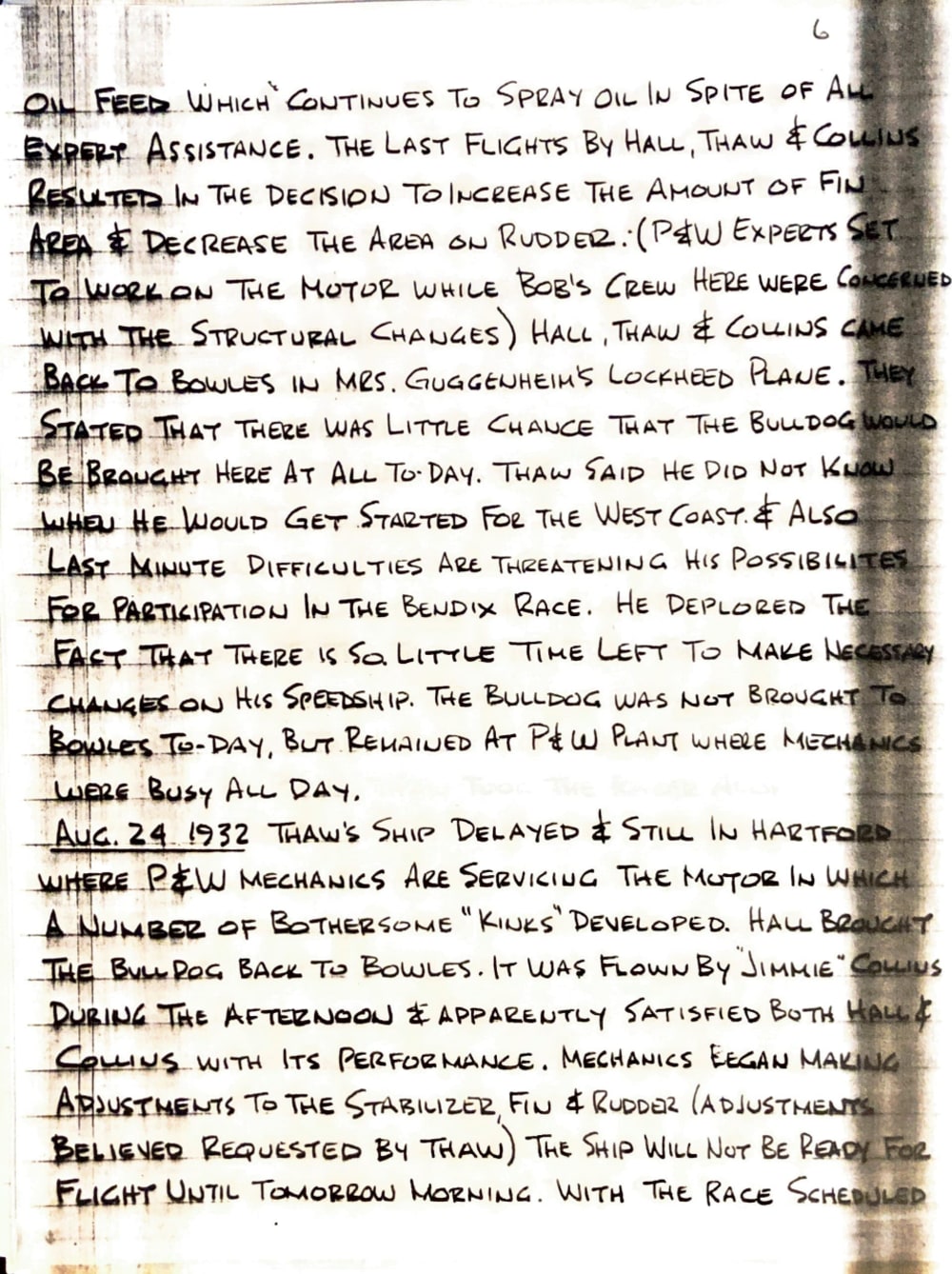
Page 6: August 23. Structural changes delay departure for Bendix Trophy. Oil feed problems persist. Decision made to increase fin area and decrease rudder area.
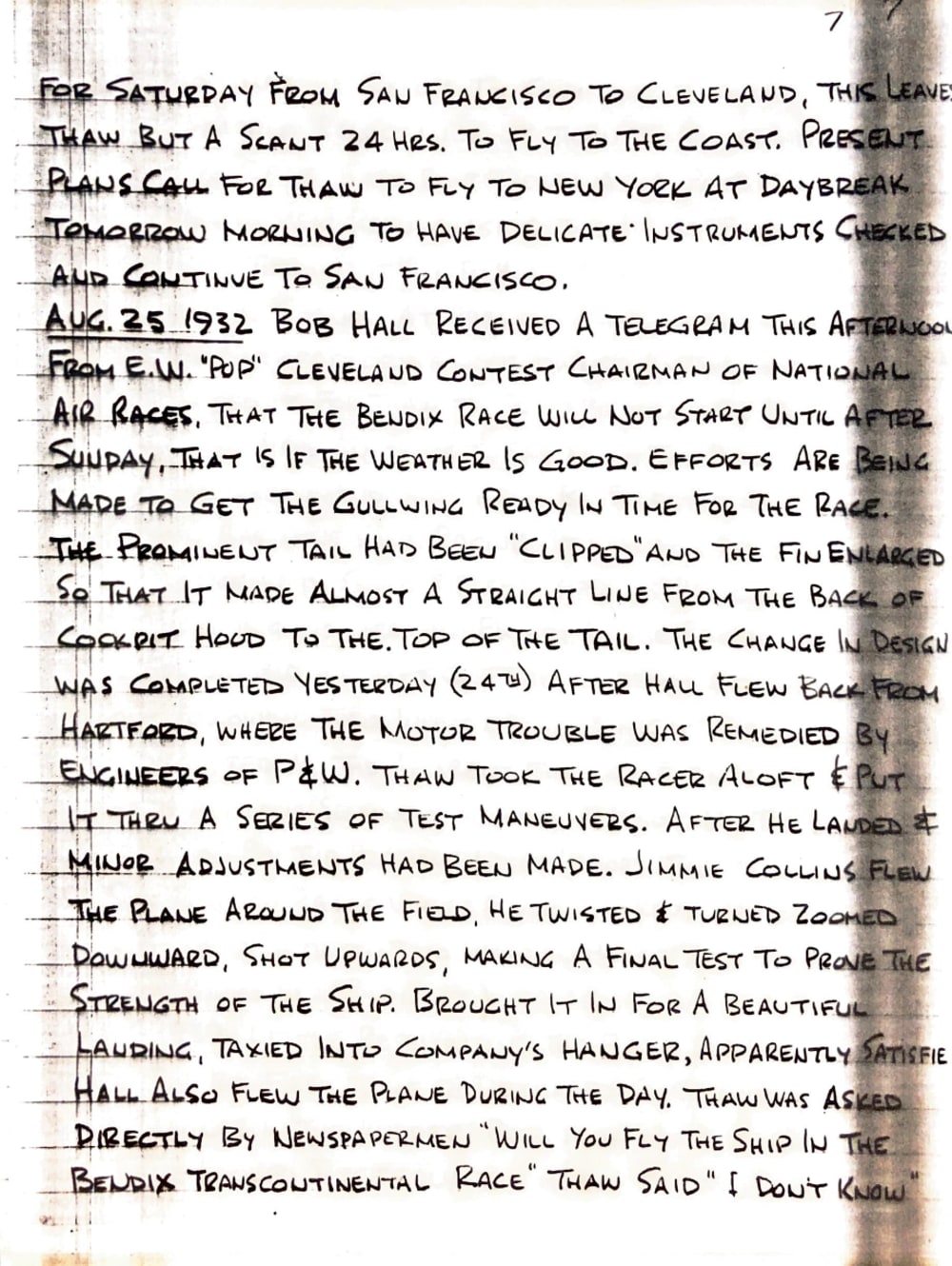
Page 7: August 24. Ship still in Hartford where P&W mechanics are servicing the motor. Jimmie Collins flies the Bulldog and is apparently satisfied.
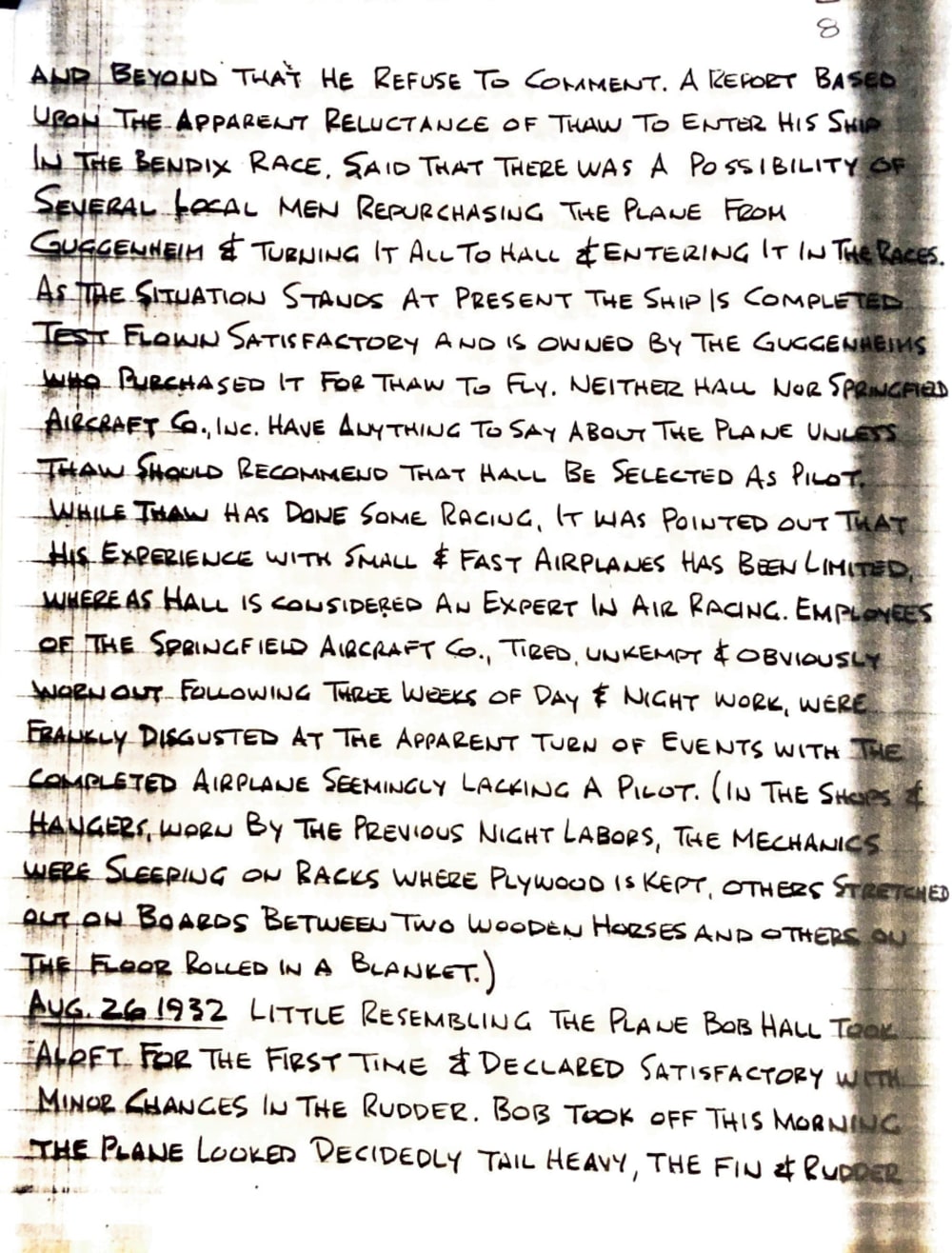
Page 8: August 25. Telegram from “Pop” Cleveland delays Bendix start until Sunday. Fin enlarged, tail “clipped” to make almost a straight line from cockpit hood to top of tail.
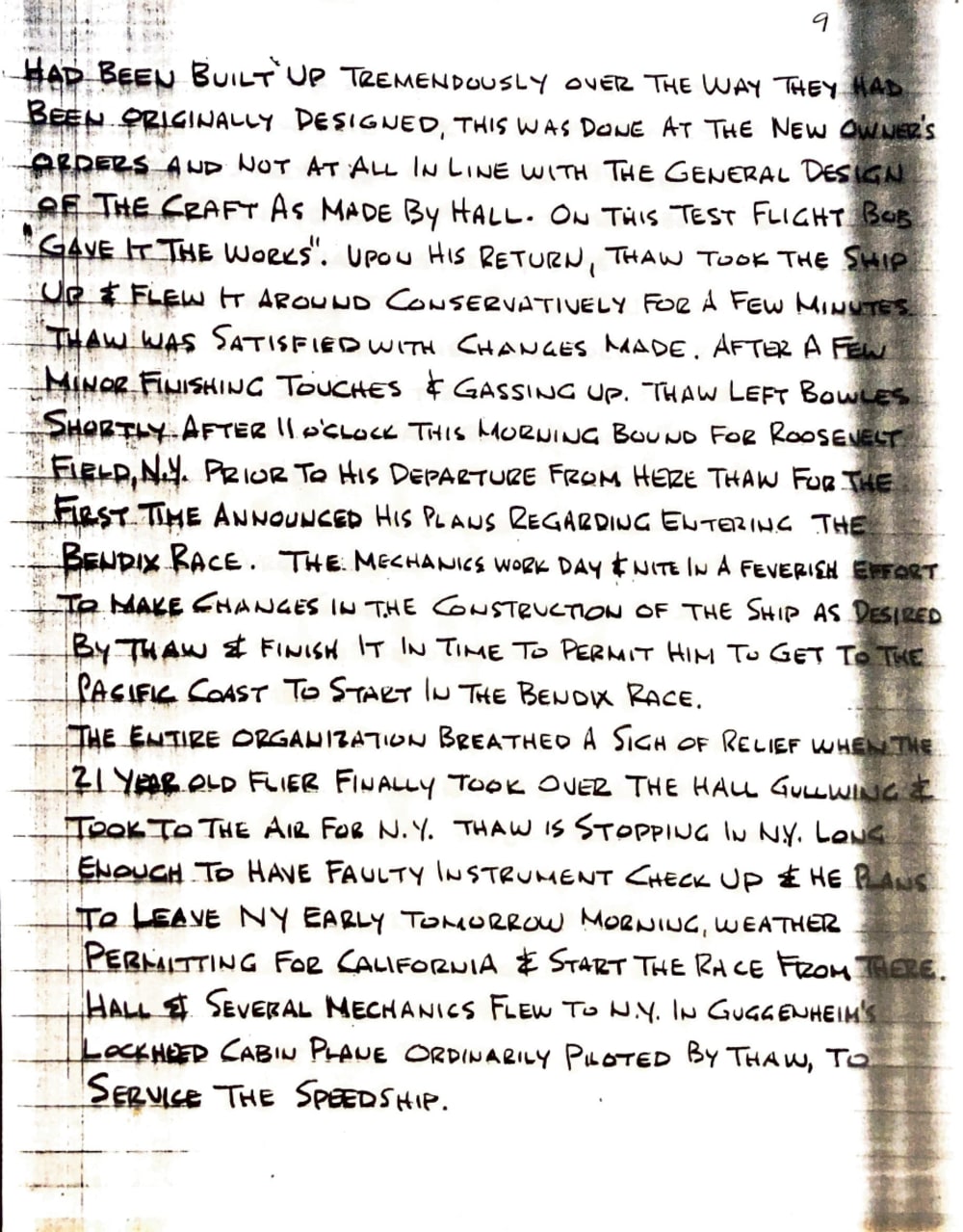
Page 9: August 25–26. Reports of Thaw’s reluctance to enter the Bendix Race. Possibility of local men repurchasing the plane and turning it over to Hall. Exhausted employees “frankly disgusted” at the turn of events.
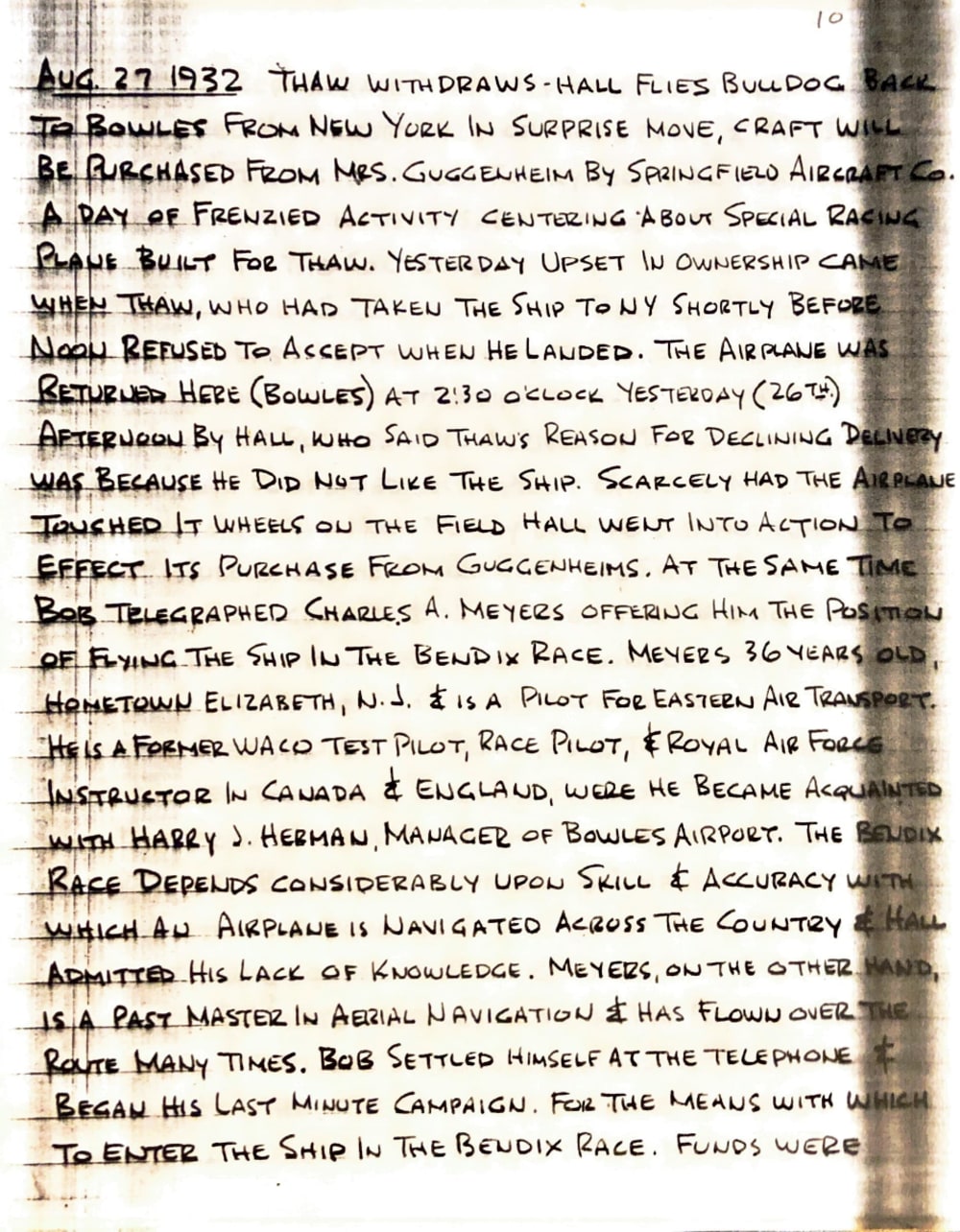
Page 10: August 26. Plane “little resembling” the original after massive fin and rudder modifications. Thaw leaves Bowles for Roosevelt Field, N.Y. Mechanics work in feverish effort to finish the ship.
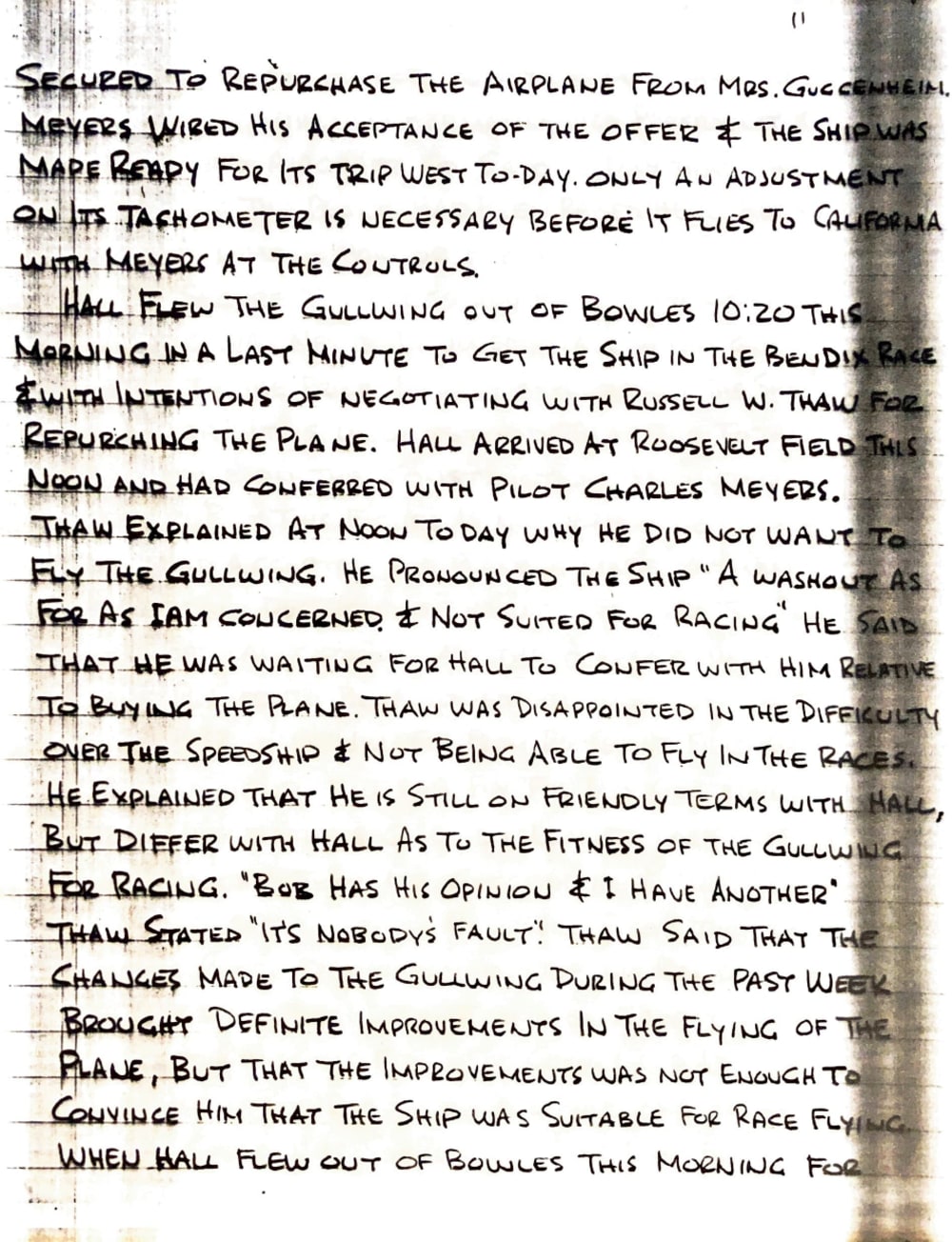
Page 11: August 27. “Thaw withdraws—Hall flies Bulldog back to Bowles from New York in surprise move.” Thaw refuses delivery, calls it “a washout… not suited for racing.” Hall immediately moves to buy back the plane from Mrs. Guggenheim.
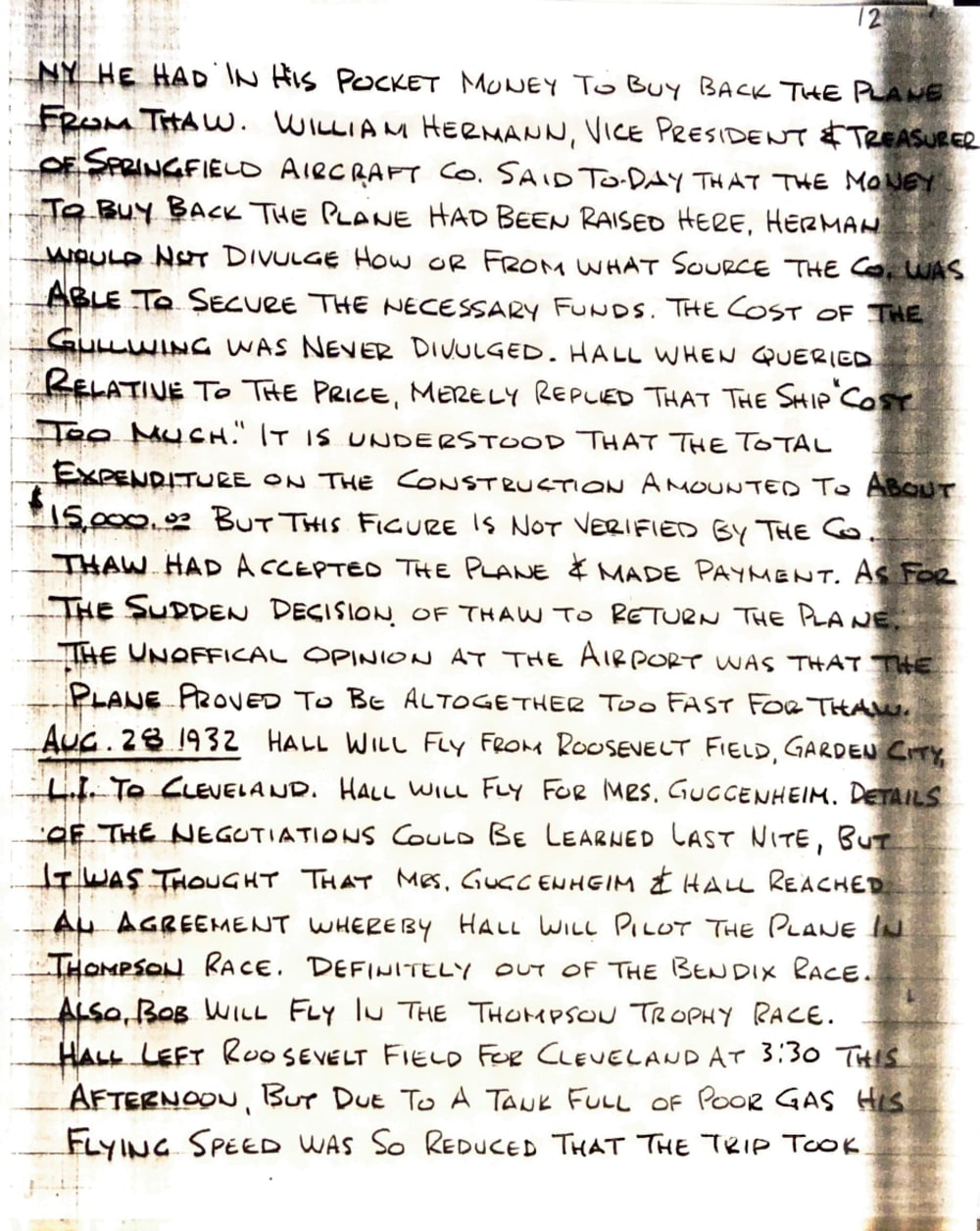
Page 12: August 27–28. Hall telegraphs Charles Meyers offering him the position of flying the ship in the Bendix Race. Hall will fly for Mrs. Guggenheim, definitely out of the Bendix but will fly in the Thompson Trophy Race.
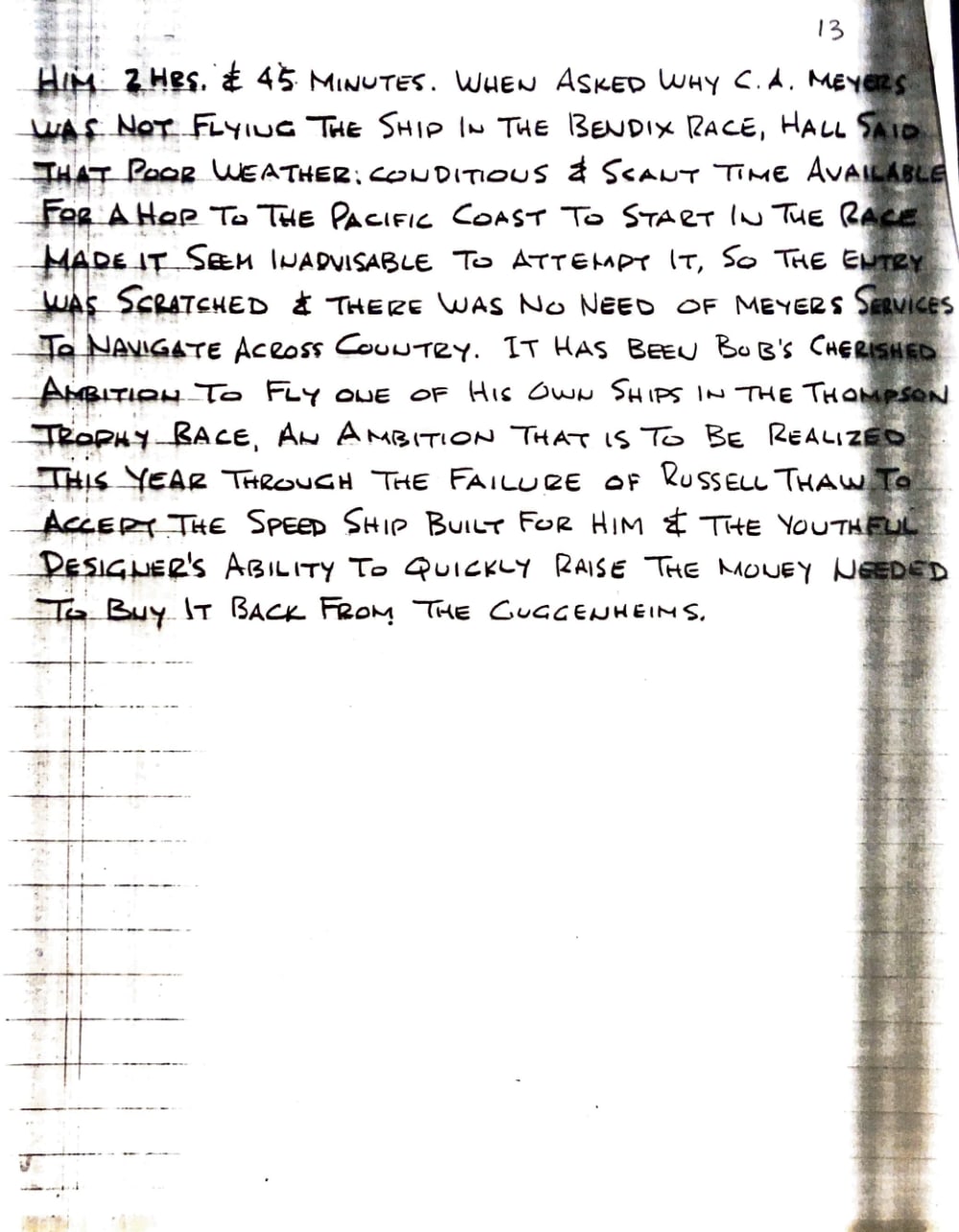
Page 13: August 28. Trip to Cleveland takes 2 hours 45 minutes due to poor gas. Hall explains Bendix entry was scratched due to weather and scant time. “It has been Bob’s cherished ambition to fly one of his own ships in the Thompson Trophy Race.”
Key Events
These notes document a remarkable two weeks in aviation history:
The Frantic Build (August 14–18)
The Bulldog was christened on August 14, 1932, with the first test flight planned for the next morning. But nothing went smoothly. A flat tire on August 15 delayed the test hop. When Hall finally got the aircraft airborne on August 16, he discovered the rudder was far too small—the ship was “very airworthy and highly satisfactory in every respect” except for directional control.
A new, larger rudder was fabricated overnight. The contract with Thaw had specified delivery by August 15, and missing this deadline cost Springfield Aircraft Co. a penalty of over $1,000.
The Near-Disaster (August 20)
On August 20, Hall nearly lost his life and the aircraft:
“Bob Hall’s nerve prevents crash while testing Bulldog at Bowles Airport. Undoubtedly saved his own life and the plane by a bit of nervy flying during a test hop. At 10 o’clock this morning when the ship attempted to barrel roll while 10 feet of the ground on take off… We all thought Bob had it.”
The left wing dropped suddenly, almost touching the ground. Hall cut the motor, somehow raised the wing, and brought the aircraft down hard on the left wheel. The sturdy cantilever landing gear—one of Hall’s design innovations—absorbed the shock and saved the situation.
The Speed Runs (August 21–22)
Once the handling issues were addressed, the Bulldog showed its potential. On August 22, Hall hit 270 mph during a test flight—though an oil leak spattered back and “completely clouded the front of the windshield surrounding the pilot’s cockpit.” Hall had to land with front vision almost completely obscured, seeing only out the sides.
The Rejection (August 27)
The most dramatic entry comes on August 27:
“Thaw withdraws—Hall flies Bulldog back to Bowles from New York in surprise move… Thaw explained at noon today why he did not want to fly the Gullwing. He pronounced the ship ‘A washout as far as I am concerned & not suited for racing.’”
Thaw, the 21-year-old socialite who had commissioned the aircraft, had taken delivery just the day before. After flying it briefly, he returned it to Bowles, refusing to accept it.
Hall Takes Over
Within hours of Thaw’s rejection, Hall was on the telephone raising money to buy back the plane from Mrs. Guggenheim. By the end of the day, he had the funds secured and the aircraft was his. The notes capture the emotional whiplash:
“Employees of the Springfield Aircraft Co., tired, unkempt & obviously worn out following three weeks of day & night work, were frankly disgusted at the apparent turn of events with the completed airplane seemingly lacking a pilot.”
And then: “The entire organization breathed a sigh of relief when the 21 year old flier finally took over the Hall Gullwing & took to the air for N.Y.”
To Cleveland
On August 28, Hall flew the Bulldog from Roosevelt Field to Cleveland for the National Air Races. The trip took 2 hours 45 minutes—longer than expected due to “a tank full of poor gas.” The Bendix transcontinental race was scratched due to weather and time constraints, but Hall would fly his own creation in the Thompson Trophy Race.
The final line captures what this meant to Hall:
“It has been Bob’s cherished ambition to fly one of his own ships in the Thompson Trophy Race, an ambition that is to be realized this year through the failure of Russell Thaw to accept the speed ship built for him & the youthful designer’s ability to quickly raise the money needed to buy it back from the Guggenheims.”
About Premo Galletti
Premo Galletti was a young man in 1932 who knew Bob Hall personally and was present at Springfield Aircraft Co. during the Bulldog’s construction. His notes have the quality of an eyewitness account—detailed, immediate, capturing dialogue and atmosphere that only someone on the ground could have recorded.
The document provides an invaluable record of not just the technical challenges of building a racing aircraft, but the human drama: the exhausted workers, the temperamental owner, the determined designer, and the last-minute scramble that got the Hall Bulldog to Cleveland.
Can you help? We’re looking to learn more about Premo Galletti—his background, his connection to Springfield Aircraft, and what became of him after 1932. If you have any information about Premo or his family, please contact me.
