The Pratt & Whitney R-1340 Wasp: Engine of the Hall Bulldog


Part of The Hall Bulldog Project — documenting Bob Hall's 1932 Thompson Trophy racer.
Explore the Project →The Pratt & Whitney R-1340 Wasp was one of the most successful and widely-used aircraft engines of the 1920s and 1930s. First run in 1926, this nine-cylinder air-cooled radial engine powered everything from military fighters to commercial transports, and most notably for this website, the legendary Hall Bulldog racing aircraft.
Setting the Record Straight: Wasp, Not Wasp Junior
Some aviation sources incorrectly state that the Hall Bulldog was powered by a Pratt & Whitney Wasp Jr. This is incorrect. The Hall Bulldog used the full-size Wasp T1D1—the same engine variant that powered the famous Gee Bee R1 racer.
The confusion likely stems from the similar names, but the R-1340 Wasp and R-985 Wasp Jr. are completely different engines:
| Specification | R-985 Wasp Jr. | R-1340 Wasp T1D1 |
|---|---|---|
| Displacement | 985 cu in | 1,340 cu in |
| Horsepower | 300–450 hp | 525 hp |
| RPM | 2,000–2,300 | 2,100 |
| Weight | 565–684 lbs | 763 lbs |
| Bore | 5.1875 in | 5.1875 in |
| Stroke | 5.1875 in | 5.5 in |
| Cylinders | 9 | 9 |
The Wasp Jr. was designed as a smaller, lighter engine for trainers and light transports. The full Wasp, with its 36% larger displacement and significantly higher power output, was the engine of choice for high-performance racing aircraft.
For detailed documentation of the Hall Bulldog’s specific engine installation, see the Pratt & Whitney Engine Installation Report, which includes Harvey Lippincott’s 1981 letter confirming the engine type as Wasp T3D1 (serial number 4820).
R-1340 Wasp Specifications
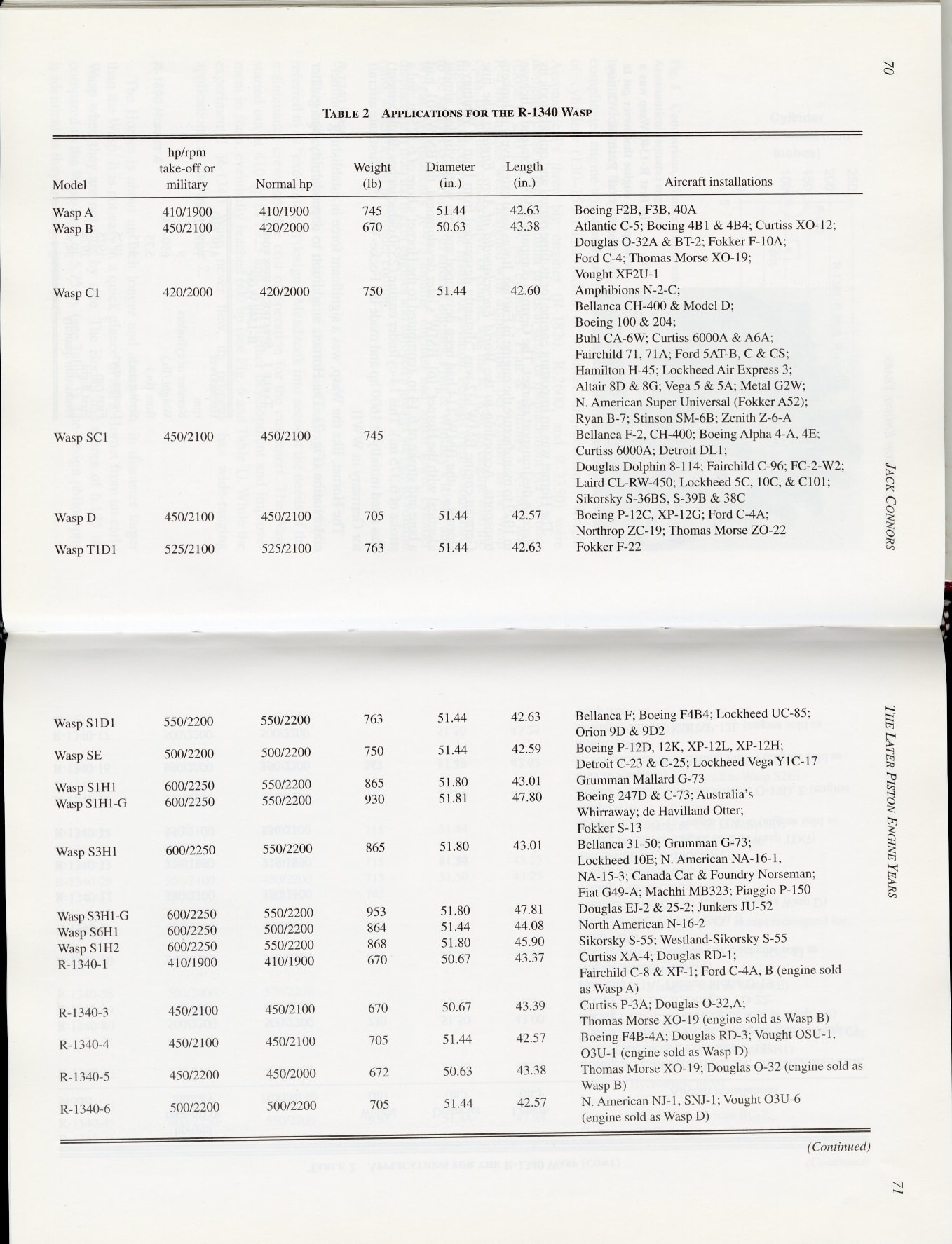
The following table shows the major variants of the R-1340 Wasp engine, compiled from Jack Connors’ authoritative reference The Later Piston Engine Years. The Hall Bulldog’s engine, the Wasp T1D1, is highlighted.
Commercial Designations
| Model | hp/rpm | Normal hp | Weight (lb) | Diameter (in.) | Length (in.) | Aircraft Installations |
|---|---|---|---|---|---|---|
| Wasp A | 410/1900 | 410/1900 | 745 | 51.44 | 42.63 | Boeing F2B, F3B, 40A |
| Wasp B | 450/2100 | 420/2000 | 670 | 50.63 | 43.38 | Atlantic C-5; Boeing 4B1 & 4B4; Curtiss XO-12; Douglas O-32A & BT-2; Fokker F-10A; Ford C-4; Thomas Morse XO-19; Vought XF2U-1 |
| Wasp C1 | 420/2000 | 420/2000 | 750 | 51.44 | 42.60 | Amphibions N-2-C; Bellanca CH-400 & Model D; Boeing 100 & 204; Buhl CA-6W; Curtiss 6000A & A6A; Fairchild 71, 71A; Ford 5AT-B, C & CS; Hamilton H-45; Lockheed Air Express 3; Altair 8D & 8G; Vega 5 & 5A; Metal G2W; N. American Super Universal (Fokker A52); Ryan B-7; Stinson SM-6B; Zenith Z-6-A |
| Wasp SC1 | 450/2100 | 450/2100 | 745 | — | — | Bellanca F-2, CH-400; Boeing Alpha 4-A, 4E; Curtiss 6000A; Detroit DL1; Douglas Dolphin 8-114; Fairchild C-96; FC-2-W2; Laird CL-RW-450; Lockheed 5C, 10C, & C101; Sikorsky S-36BS, S-39B & 38C |
| Wasp D | 450/2100 | 450/2100 | 705 | 51.44 | 42.57 | Boeing P-12C, XP-12G; Ford C-4A; Northrop ZC-19; Thomas Morse ZO-22 |
| Wasp T1D1 | 525/2100 | 525/2100 | 763 | 51.44 | 42.63 | Fokker F-22; Hall Bulldog; Gee Bee R1 |
| Wasp S1D1 | 550/2200 | 550/2200 | 763 | 51.44 | 42.63 | Bellanca F; Boeing F4B4; Lockheed UC-85; Orion 9D & 9D2 |
| Wasp SE | 500/2200 | 500/2200 | 750 | 51.44 | 42.59 | Boeing P-12D, 12K, XP-12L, XP-12H; Detroit C-23 & C-25; Lockheed Vega Y1C-17 |
| Wasp S1H1 | 600/2250 | 550/2200 | 865 | 51.80 | 43.01 | Grumman Mallard G-73 |
| Wasp S1H1-G | 600/2250 | 550/2200 | 930 | 51.81 | 47.80 | Boeing 247D & C-73; Australia’s Wirraway; de Havilland Otter; Fokker S-13 |
| Wasp S3H1 | 600/2250 | 550/2200 | 865 | 51.80 | 43.01 | Bellanca 31-50; Grumman G-73; Lockheed 10E; N. American NA-16-1; NA-15-3; Canada Car & Foundry Norseman; Fiat G49-A; Macchi MB323; Piaggio P-150 |
Military Designations (Selected)
| Model | hp/rpm | Normal hp | Weight (lb) | Diameter (in.) | Length (in.) | Aircraft Installations |
|---|---|---|---|---|---|---|
| R-1340-1 | 410/1900 | 410/1900 | 670 | 50.67 | 43.37 | Curtiss XA-4; Douglas RD-1; Ford C-4A, B (engine sold as Wasp A) |
| R-1340-7 | 450/2100 | 450/2100 | 700 | 51.43 | 42.59 | Boeing P-12; Douglas BT-2, 2A, 2B, 2B1, 2BG, 2BR, 2C1, 2C, O-32A; Lockheed C-12 |
| R-1340-9 | 450/2000 | 450/2000 | 700 | 51.43 | 42.59 | Boeing XP-12A, B; Douglas YO-22; Fairchild F-1A; Thomas Morse O-19 |
| R-1340-16 | 550/2200 | 550/2200 | 763 | 51.43 | 42.63 | N. American SNJ-1; Boeing F4B-4 (engine sold as Wasp S1D1) |
| R-1340-AN-1 | 600/2250 | 550/2200 | 865 mag / 878 alum | 51.81 | 43.00 | Boeing AT-15BO, XAT-15; Bellanca AT-15BL; Cessna C-106A; Chase XPG-4; Fairchild XAT-13, AT-13; McDonnell AT-15MC; Noorduyn YC-64, C-64A, C-64, UC-64B, AS, AT-16; Harvard II; N. American SNJ-2, -3, -4, -5, -6; AT-6B, C, D, F; Piasecki HRP-1, -2 |
| R-1340-AN-2 | 550/2200 | 550/2200 | 938 | 51.81 | 47.80 | Goodyear Navy ZNPK, ZNPM |
Production Success
The R-1340 Wasp was remarkably successful. According to Connors, the engine’s reliability and power made it the standard choice for a generation of aircraft. Pan American Airways alone operated 264 Wasp-powered flying boats, using various models from the 450 hp R-1340 to the 1200 hp R-1830.
The Wasp Jr. (R-985) was introduced later as a training aircraft engine, with first flight in August 1929 and total production of 39,037 units. While highly successful in its own right, it was never intended for the high-performance racing applications that demanded the full-size Wasp.
Download Source Material
Source
Specifications compiled from: Connors, Jack. The Later Piston Engine Years. Pages 70–83, Table 2: “Applications for the R-1340 Wasp” and Table 8: “Specifications for the R-985 Wasp Jr.”
