Pratt & Whitney Engine Installation Report


Part of The Hall Bulldog Project — documenting Bob Hall's 1932 Thompson Trophy racer.
Explore the Project →In October 1981, aviation historian Michael Kusenda of Cleveland Heights, Ohio wrote to Pratt & Whitney seeking information about the engine used in the Hall Bulldog. The response from Harvey H. Lippincott, Corporate Historian & Archivist at United Technologies, included xerox copies of the original 1932 installation reports—documents that provide invaluable technical details about this remarkable racing aircraft.
Download Original PDF
(3.9 MB)The Letter from Pratt & Whitney
On October 26, 1981, Harvey Lippincott responded to Kusenda’s inquiry with the following letter:
Dear Mike,
In reply to the questions in your letter of Oct. 22, 1981, although we do not have the records to prove it, it appears logical that the s/n 4820 P&WA Wasp was the same T3D1 model as s/n 4819 and that both engines could have generated 730 h.p. at 2,300 r.p.m.
The s/n 4820 engine was on consignment to the Springfield Aircraft Company, Inc. Therefore, P&WA remained the owner of the engine. After the race, it would have been returned to the factory and completely overhauled, checked for damaged and worn parts, and modified parts—such as carburetor and pistons—replaced with production model parts. It would then get a new designation and a new data plate. Again, we do not have the records to prove it, but it is possible that s/n 4820, redesignated S3D1, could have been purchased by Mrs. Guggenheim for the Lockheed Vega.
By the way, Mr. Fales first name is Herbert, not Harvey.
I’m enclosing xerox copies of the installation reports for the V-1 “Bulldog.” I do not believe you have them.
Sincerely,
Harvey H. Lippincott Corporate Historian & Archivist UTC Archive & Historic Resource Center
Address: 400 Main St. Airport Office Annex East Hartford, CT 06108
Key Technical Details
The enclosed installation reports reveal several important specifications about the Hall Bulldog:
Engine
| Specification | Value |
|---|---|
| Type | Pratt & Whitney Wasp T3D1 |
| Serial Number | 4820 |
| Power Output | 730 hp at 2,300 RPM |
| Carburetor | NAY-8E |
| Spark Plugs | 4B2 |
Propeller
| Specification | Value |
|---|---|
| Type | Hamilton Standard Controllable |
| Diameter | 8’ 1” |
| Blades | 2 |
| Material | Aluminum |
| Level Flight RPM | 2,300 |
Fuel System
| Specification | Value |
|---|---|
| Capacity | 210 gallons |
| Tank Location | Fuselage |
| Fuel Pump Type | Evans |
| Main Feed Line | 1/2” |
| Flow Rate | ~90 gal/hr expected |
Weights & Performance
| Specification | Value |
|---|---|
| Empty Weight | 1,750 lbs |
| Gross Weight | 3,250 lbs |
| Top Speed | 285 mph |
| Wing Area | 80 sq ft |
| Wing Loading | 40.2 lbs/sq ft |
Construction Notes
From the July 15, 1932 daily report by P&W engineer Erik Hofman:
Fuselage, wing and engine mount structure completed. Fuselage is a very heavy looking steel tube structure. The wings are of wood construction fabric covered. Two solid spars about four inches thick, ribs onabout 3” stations and compression members about 15% apart. Wing area to be 80 sq ft which gives a wing loading of 40.2 lbs/sq ft. Est net weight is 1750 lbs Gross 3250 lbs Fuel 206 gals. The plane resembles Lynch’s plane (Wasp Jr) also built by Hall in appearance.
Hofman also noted discussions with Bob Hall about the exhaust configuration, fuel pump selection, and preheater choices—providing a fascinating glimpse into the engineering decisions being made during the aircraft’s construction.
The Installation Reports
The following pages are the original Pratt & Whitney installation reports from 1932:
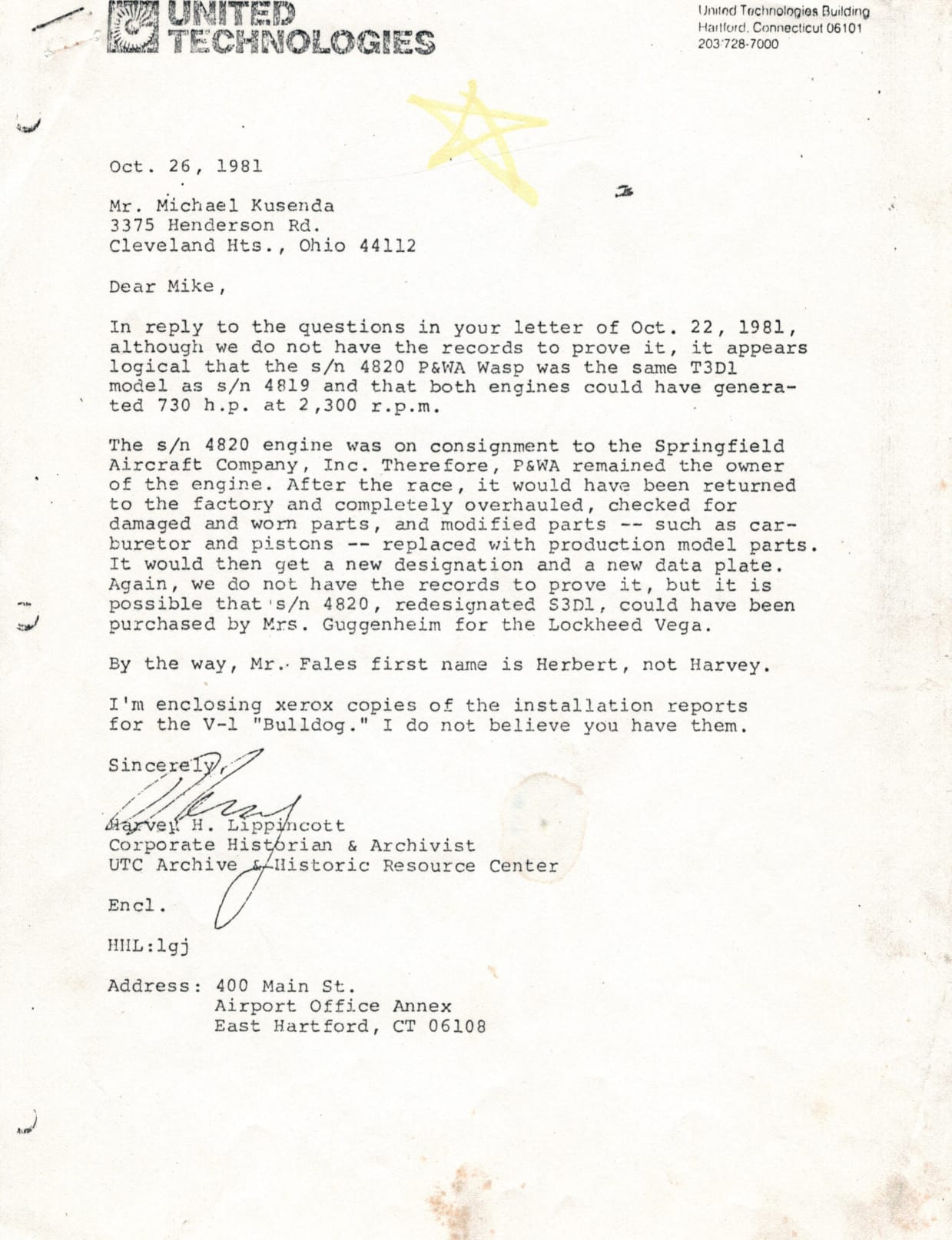
Page 1: Cover letter from Harvey H. Lippincott, Corporate Historian at United Technologies (October 26, 1981)
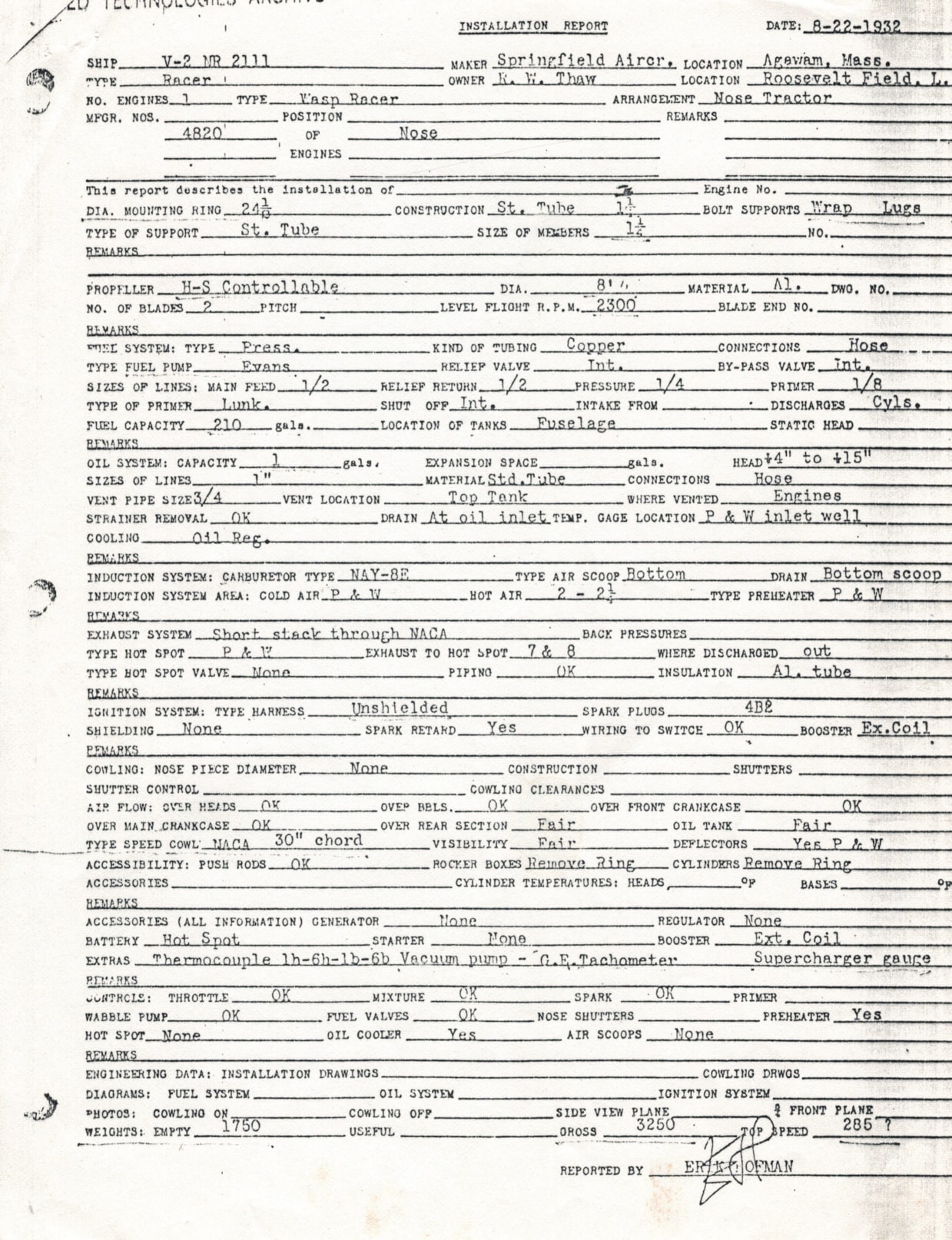
Page 2: Installation Report for the V-2 NR 2111 “Bulldog” (August 22, 1932). Details the complete engine installation specifications including fuel system, oil system, induction, exhaust, ignition, cowling, and accessories.
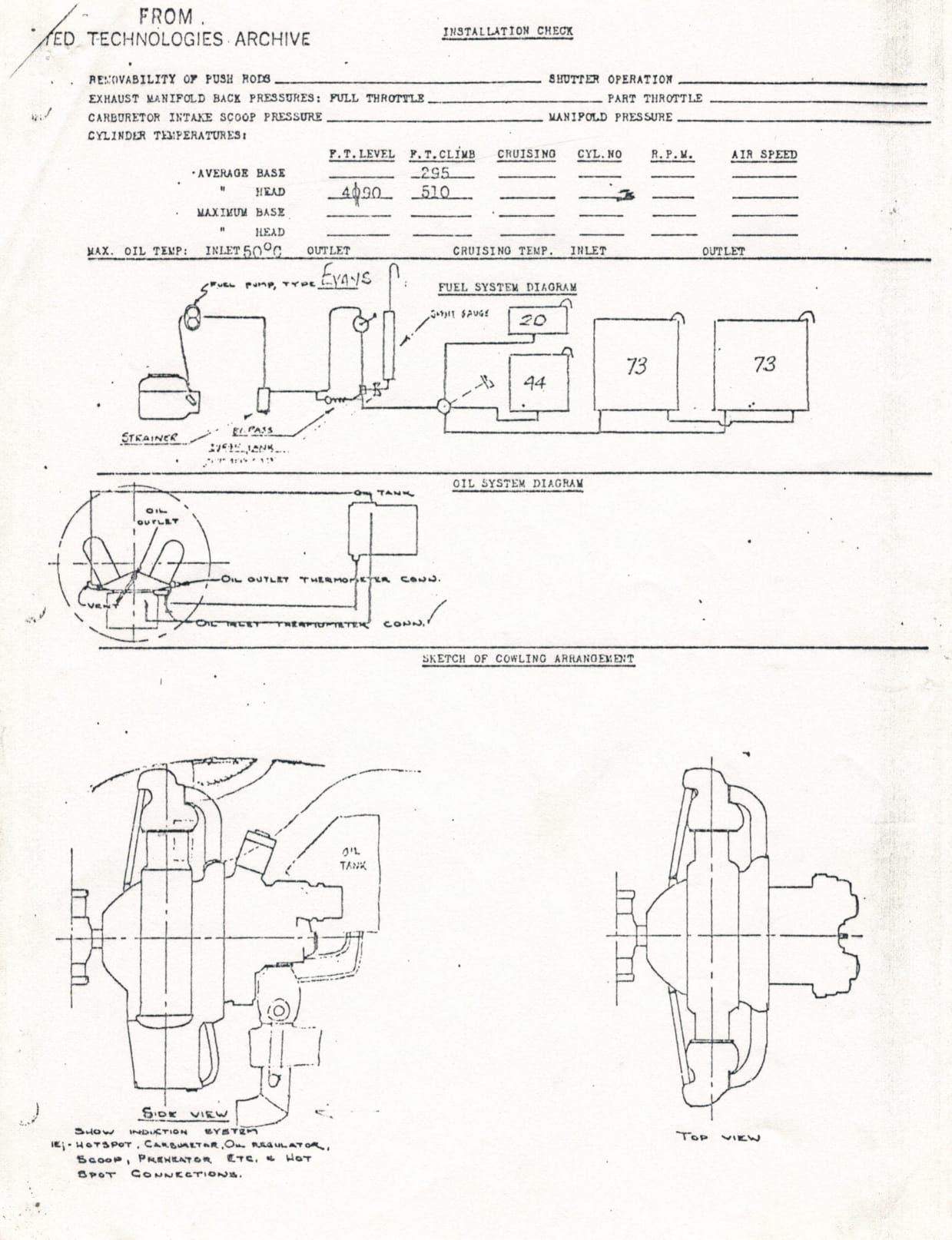
Page 3: Installation Check with hand-drawn diagrams of the fuel system, oil system, and cowling arrangement.
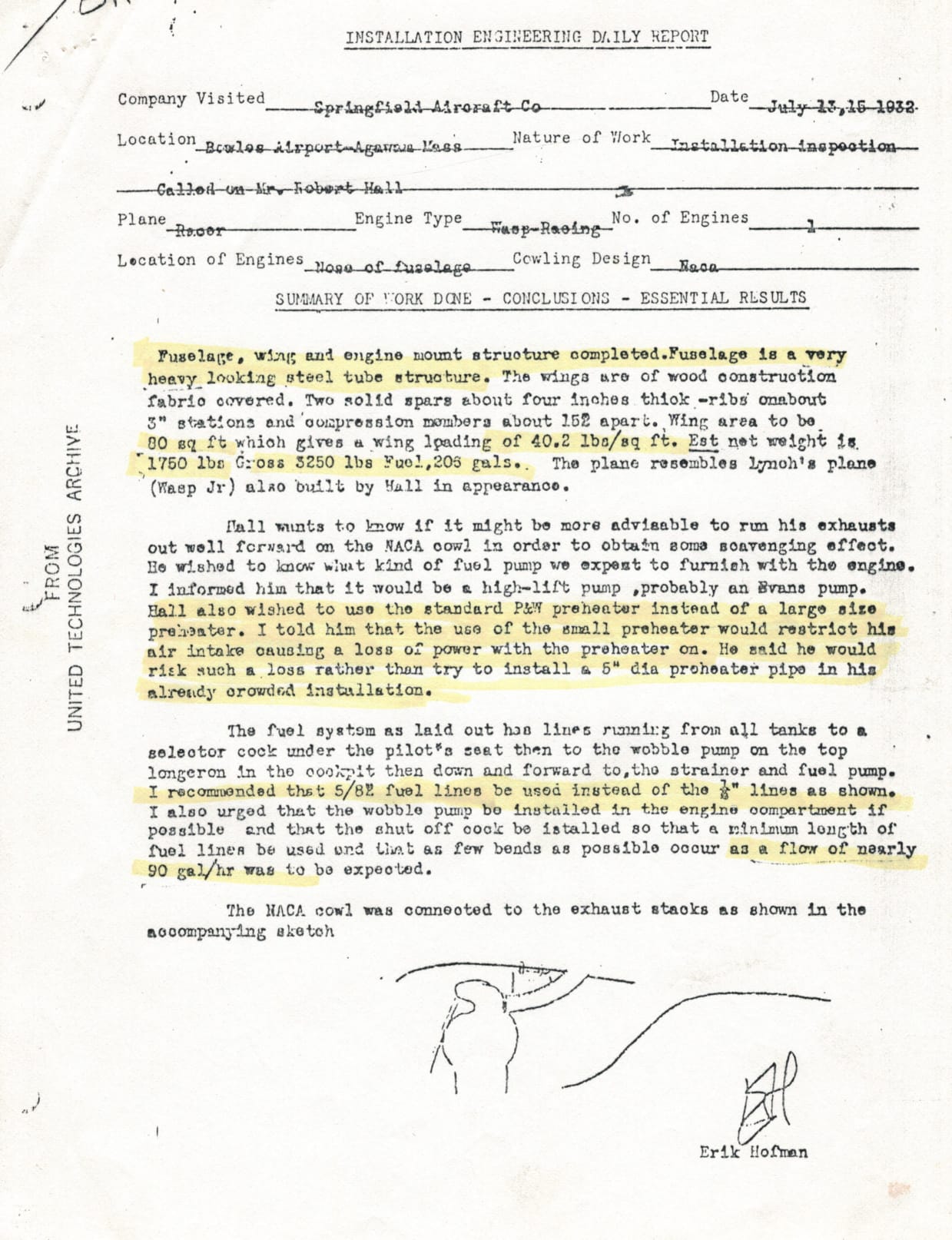
Page 4: Installation Engineering Daily Report by Erik Hofman (July 15, 1932). Documents his visit to Springfield Aircraft Co. at Bowles Airport, Agawam, Mass., and his observations on the aircraft’s construction progress.
Historical Significance
These documents are remarkable for several reasons:
-
Engine Provenance: The letter confirms the engine was serial number 4820, on consignment from Pratt & Whitney to Springfield Aircraft Company. P&WA retained ownership, which is why the engine was returned after the race.
-
Performance Confirmation: The 730 hp at 2,300 RPM figure had been uncertain—these documents provide authoritative confirmation directly from Pratt & Whitney’s archives.
-
Guggenheim Connection: Lippincott speculates that after being overhauled and redesignated, the engine may have been purchased by Mrs. Guggenheim (who financed the Bulldog) for use in a Lockheed Vega.
-
Construction Details: The daily report from July 1932 captures the aircraft during construction at Bowles Airport, with specific details about wing loading, fuel capacity, and structural design that match period photographs.
-
Engineering Discussions: The report records direct conversations with Bob Hall about technical decisions—exhaust placement, fuel pump selection, and preheater configuration—providing insight into the designer’s thinking.
These installation reports, preserved through the diligence of aviation historians like Michael Kusenda and archivists like Harvey Lippincott, help ensure that the technical legacy of the Hall Bulldog is not lost to history.
