Stressful Coexistence


Originally published in Sport Aerobatics magazine, November 2021 issue.
Join the IAC →
Stressful Coexistence
Competition aerobatics is a very stressful activity. The stress of competition is obviously most evident in the air, where our competitors strain themselves physically and mentally in the pursuit of perfection, but the stress of competition is also present on the ground.
Competitors feel stress even when they are not flying. They worry that they might not have practiced enough, that they might have a mechanical issue with their aircraft, that they will forget a figure during their flight, or that the winds might pick up just when it is their turn to fly.
This stress works against the competitor’s goals of putting 100% focus on their execution. To be a great competitor, you must master yourself and ensure that you are in the right mental state ready for your performance. You must be confident and calm to face the challenge of flying in competition, and you must have the ability to forgive yourself for your past mistakes so you can put them entirely out of your mind as you take to the air.
Everything I just said about competitors applies equally to our non-flying contest volunteers. Their role is just as important as the competitor, and just as stressful. They prepare themselves for the high-pressure environment of a contest. They lose sleep. They worry they will make mistakes. And the pressure they feel to perform interferes with their ability to execute.
If I could wave a magic wand and fix one major IAC problem, it would be to magically get everyone in this sport seeing how hard everyone involved is working so carefully to do things for each other. I would make everyone forgive each other and themselves and move forward with the past behind them. We do not all get it all correct every single time, but we do what we do out of love for the sport and each other, and no one involved should ever feel ashamed for putting forward their best effort.
Keep all of this in mind the next time you feel stress. Everyone else is feeling it too so we all have that in common! It is on all of us to keep that in mind and be as forgiving and understanding of others as we want them to be of us. Competition aerobatics is not for the faint of heart! Just get out there and give it your best!
The Right Frame of Mind
I brought up the subject of “stress” because it was an important thought for me this year as I worked with a new coach. I arranged for Olivier Masurel, from the French Aerobatic Team, to train me in preparation for the US National Aerobatic Championships.
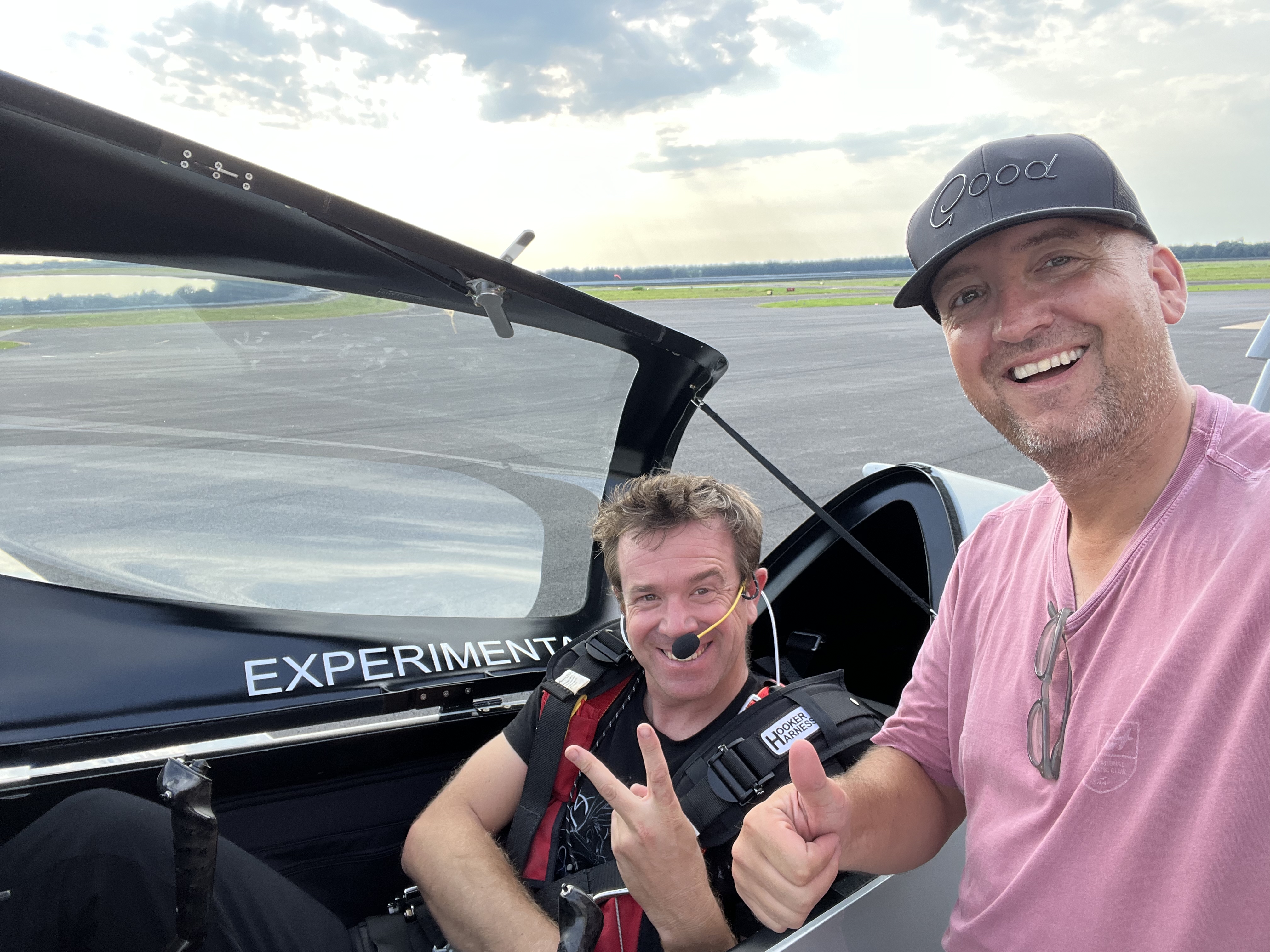
Olivier’s approach reminds me of US Team Coach Claude “Coco” Bessiere’s methods, which makes sense of course because they are both French. But Olivier focused a lot more on mental preparation and I found it very helpful.
Once an aerobatic pilot has learned the right techniques and has built up the correct muscle memory to execute aerobatic figures in practice, the next step is to prepare them for the actual competition. Performance in practice and performance in competition should be the same, but a pilot’s mental state in the days leading up to a competition can change dramatically, usually for the worse. How much it changes depends on the person, but there is probably no one alive who is in the same mental state on the day of the contest than they were a week prior.
Olivier taught me a lot about how to put myself in the right mental state and keep myself there. It helped me perform my best at Nationals. I really enjoyed working with him. His tips are to have confidence, to focus on the next flight, and to prepare yourself very carefully. It’s not enough to just memorize the figures and walk the sequences. You need to do it like you are in the airplane and you must think about all the forces you will endure, what you will see, and where you want to be in the box. I realized during this week that I had never before truly prepared myself for a flight. It makes a difference.
The US Aerobatic System
During my time with Olivier, I had a great opportunity to talk to him about the French system vs the American system. The truth is we don’t have a “system” here, but it seems that in France they do. He was very surprised to learn how little aerobatic dual instruction we get, how we allow people to move up in categories freely at their own pace, and how easy our sequences are. They have more categories than we do and they split things up into “two seat” vs “single seat” categories so that the lower category pilots are never competing against the high end carbon fiber planes. You must score at least 70% to move up and for every category you must know how to fly the figures before you advance. They have a category in between Advanced and Unlimited which helps people transition.
Their entire system is designed to be very considerate for the pilots. There is a training program that allows pilots to build skills using volunteer or professional instructors. I mentioned before that when I trained in France for the 2019 WAC I was stunned at how much aerobatics knowledge there was at the club level. We would do well to absorb some of their good ideas so that our pilots can be safer and more prepared.
I’m also in good contact with pilots from other countries and everyone I talk to tells me we are struggling because we expect our pilots to figure out too much on their own. Last year the IAC Board approved the formation of a committee to review our category structure and make recommendations. It would be nice to take a lesson from other countries. I’ll keep in touch with Olivier and my other international contacts and try to sort out which of their ideas can fit into our way of doing things. This year the CIVA annual meeting is in Dallas, TX which gives me an additional opportunity to share ideas.
In Closing
That’s all for me this month. Please keep your comments coming to president@iac.org!
